It's been a busy and productive time, and this explains the dearth of recent posts. However, I have new pieces upcoming in five journals, in the following alphabetical order (links added as available):
Draft: The Journal of Process, and their Marginalia blog will feature my piece "False Memoir, True Fiction: The Slippery Slope."
JMWW will publish "Survey" on August 17th.
Fiction Southeast will publish "Be Proud, Be Brave, Aspire!" on August 25th. This piece was originally written for a feature in a national magazine, and focuses on my ambivalence about the writing life.
Fjords Review will publish "Verse for the Averse", my review of Ben Lerner's "The Hatred of Poetry". I've been an avid Lerner-ite since I've read his two novels, and have recently started dipping into his poetry.
Juked will publish "Domestic Triptych", which continues in a vein of short fiction I've been writing about relationships.
Newfound will publish "Writing Contra Technology", my review of Sven Birkerts's "Changing the Subject: Art and Attention in the Internet Age". This book is a follow-up to his Gutenberg Elegies.
Thanks to the terrific journals and editors of the above. Links to follow when available.
Showing posts with label blogging. Show all posts
Showing posts with label blogging. Show all posts
Monday, July 25, 2016


Monday, June 22, 2015
Guest blog post up at Superstition [Review]
The Literary is fast approaching seven years old in August. When Superstition Review asked me to write a guest blog post, I was given carte blanche to write about anything I wanted. After four fits and starts, some of which made more sense in a different context, I hit on a novel idea. In honor of the seven year itch, I decided to write about--this blog. That piece, "From Journal into Blog: Seven Years of Writing on Writing", is available here. But this brings up something more important I want to say.
 In the ten plus years that I have attempted to craft words, I have never found so welcoming and encouraging a literary journal as Superstition Review. First of all, they saved from mild obscurity a story that had made the rounds so many times it was like a bad date you keep reminding yourself to forget (though I remind myself, this had nothing to do with its merit as a short story). And after it resurfaced, I realized that yes, I still love that story as I love a little all of my stories, long after they’ve been published and more or less forgotten. Then S[R] allowed me--asked me if I was interested, rather--to sit and promote my novel at their table during AWP in Minneapolis this past April. And finally, they asked for a guest blog post! Great folks.
So, I’m extremely grateful to Trish Murphy and the staff at Superstition Review--check out the photo from AWP, above.
Tuesday, August 9, 2011
Third Anniversary Toast
The most interesting writing projects, for me, have come about through experiment. It may spring from the thought: should I try this? But often that is enough to get the notes down on paper that will spark to life. The Literary, the blog you are reading which I started three years ago--begun before the first groans of the greatest recession of our era--was just such an occasion. I’d wanted a place to post reviews, news and thoughts about the one subject that never ceases to excite my enthusiasm and obsessions. Incidentally, for someone who used to start things he couldn’t finish, a blog is the ultimate tool for procrastination.
When I assess the writing on this blog, it isn’t necessarily a lot of work for a three year period, though it has accumulated to a decent book length draft. I may not post as frequently as I should, if I am thinking about numbers and getting hits. But since I haven’t been thinking only about numbers and hits, I’ve tried to be diligent, consistent and tactful in my writing. This process takes more time than I can usually anticipate, considering my ambition. Having a web presence is better than none, perhaps, and this blog has helped me land more work and place pieces that I might not have otherwise attempted. The Literary has kept me on my toes when I’ve detoured from fiction. In retrospect I’m pleased with the material in this blog, and can say that I set out to do exactly what I have done with it. Thanks to everyone who has commented or sent me a note over the years.
Since art is long, money expendable, and the economy is like an unfortunate roller coaster ride, for now I’m going to keep looking forward and offer a third anniversary toast.
Thursday, March 3, 2011
Writing Ad Infinitum
Writing, like any craft, is something you do because you have to, at least in its most rewarding manifestation. Or, more generously, because you want to. This has nothing to do with writing for pay, for there’s little of that to go around. Yet, regarding writing for pay, no matter how good you are at it, you’ve got to get to certain unlikely heights or unquantifiable hype before a wide audience will read you, but even then, you don’t necessarily have to be good at it. Although it might serve you, the aspiring writer, in the long run, to improve at it.

After you’ve come to terms with the reality that you have to do it, the struggle is to probably get noticed; all you can do is work to make the best writing possible, all that you have control over is to challenge yourself. As a writer writes to be read by a number of people, you confront the transition of private to public, then, and decide, I am a writer. You recognize you want to connect with other writers, and eventually, readers.
These are wonderful notions in themselves, but far too idealistic to get you to the next step.
For years, you will rework a manuscript that you are convinced is publishable; it is not. After yearly disinterment and brushes with hope, you will rechristen it with a pithy, though enigmatic title, say, “Messenger” or, “The Adjective Noun of Proper Name,” ultimately dropping the definite article because it makes the work sound more professional, more befitting a work of literary art. You will find an agent who reads said novel twice in two years. (She has it in her hands for that period--who knows if she actually reads it.) Once, you will stay after work and retype the entire manuscript late into the night because you don’t have a copy in a file format you can print out from your workplace. In this marathon session that could put Kerouac to shame, you will inadvertently riddle the MS with errors you don’t have time to catch. You will insist on sending out bound copies single spaced, of your manuscript, until a knowledgeable friend tells you that there is something called “industry standards.” You will learn these and stop sending out unprofessional formats of your writing.
You shouldn’t expect anyone to take notice. You hope someone will read you and connect with your work, and conceive of ingenious, though mind boggling and time consuming schemes to make this happen. This requires a degree of marketing and selling to rival a fortune 500’s advertising campaign. You will send your work out and receive enough rejections to save the rainforest, or at least to wallpaper every square inch of your walls in the theme of “rejection letter boogie.”
You will submit to contests so often that you don’t even remember what you sent where. You will put so much extra money into this that you could have funded a writing year abroad where you could forget too much about a “writing career”. You will establish a rigorous system of sending at least one hundred and forty submissions a month and maintain a byzantine excel spreadsheet to track them, and then you will abandon it because it takes up too much writing time. You will send stories out when you feel like it. You will send stories out when you absolutely do not feel like it. You will stop sending stories out so that you can work on your novel, which will take one year, then two years, and longer. You will keep focused on what’s important, the work. Nothing else will matter, really, but you won’t admit this to anyone. You will realize getting published is sort of a great thing, and yet not always as great as you imagine it will be.
Once editors acknowledge and publish your work, however, you’ll find that publishing a short story is not enough. Why? It just never is. You want bigger rewards, bigger pay-offs, more kudos. This, if you are not careful, can give you an assumed rewards expectation which can lead to violent attacks of hubris, mislaid entitlement, and an all around general boorishness that will garner you no respect whatsoever from your peers.
A little reward will sometimes mean a lot. You would not have stayed with writing if you hadn’t improved at it (though that seemed to take years due to a stubbornness and cluelessness about following basic grammatical rules, something to this day you are occasionally defiant about, when you are not outright dubious), and you probably wouldn’t have continued if no one published anything you’d written. On the other hand, this is difficult to say: you’d already been at it for years with nothing to show for it when you finally decided, for the third time, that you’d apply to several estimable creative writing programs and go back to school to pursue an MFA, much to your family and friends' pitying and doubtful looks.
You will finish your MFA, after two years of self-flagellation and hard work, and get annoyed when people knock MFA programs as worthless, saying they produce lackluster writers who have a cookie-cutter approach to fiction. After your many hundreds of pages of theses, fictions, and musings, you are convinced there isn’t anything such as cookie cutter writing. There are boring writers and there are interesting writers. There are great boring writers and great interesting writers. You will hope that you are in the latter category (G.I.W.) Writing isn’t easy.
Maybe there are people out there who have done it effortlessly, but you come to believe most success is ninety percent hard work. You will say that in a generous mood; in a bad one, you’ll say someone with a great success just got lucky, and you’ll inadvertently rip a few writers out of envy (but where on earth does that get you, really?). On some days, you will contend with watching a crop of younger writers who you see gliding along as if in an easy self-sustaining clique that publishes its members’ work regularly and widely while your work is disregarded, when, in fact, your writing is probably equally compelling, worthy of accolades, and accomplished, if not, dare you say it, more so. But you don’t for once feel luck with what you do. You feel grateful for your patience and perseverance.
Things change; you progress. You work at writing long enough and you become proficient. Barring that, technology arrives and you discover the blog, where you can write (and publish!) any old thing you like, though you recognize the thirty million other blogs you compete with, and that yours is not so timely. You choose not to care--it’s an outlet to write on your favorite subject. Nor do you post seventeen times a day and link to every conceivable blog post with the slightest reference to your insightful topic. An added bonus of your blog is that you can write during the off times when you are wrestling with whether to switch your four-hundred page novel from past to present tense, though you wonder if this spontaneous and possibly frivolous decision will destroy two years of work.
For enough times as you have stories published, you’ve not yet had a novel published, and it’s not been for a lack of trying. But what you realize is that your personal vision of your work, and any kind of outside acknowledgment must be compartmentalized in order to continue through the silent reception you believe you are receiving. In other words, you have to banish such thoughts about even having external rewards from your thinker like an ancient yogi master, if you want to continue. As well as a novel is or is not going, the frustrating struggle to find an agent, or drum up the enthusiasm to keep working on the novel, is often at odds with the desire to have a readership. It can be too easy to feel embittered or ambivalent at your colleagues’ successes, even though you should take their arrival as a measure of you own success, or at least your proximity to it. Though it’s almost easier to consider disparities: how much less time (you believe) they’ve had to struggle, how readily agent X must have responded to their query, whereas all you received from said agent was a fifteenth generation xerox of a rejection letter so badly faded that trying to read the return address is like trying to decipher the Maya codex.
You will even harbor doubt about attempting to state your situation in anything other than cynical terms, as if you’re not allowed optimism; it will become difficult to maintain hope when you feel what’s really more appropriate is gallows humor, and a measure of downright crabby cynicism.
You have to learn to see yourself outside of much of this, and take solace in your own path for it has allowed you to reach the point when others will have already given up. You will not know how to give up. You are like an ultra long distance runner: your work makes no sense to most who are not themselves, running, and for anyone else, your endurance, dedication, and discipline can seem crazy or ill-advised for the presumed meager rewards that you may or may not receive.
You have to believe in and rely on your writing community, however obscure, that supports you unconditionally. You will have learned, against what you believed, that you can sometimes get by and even thrive on such support. Because at some point you did go looking for a community, which is maybe what was missing from your efforts those first years.
All you can do, finally, is the work, the eternal return to the well, cultivating the satisfaction and the inspiration you always have been able to, maybe more than should be humanly expected. Inspiration is not a matter of frequency, it’s about courting the fickle muse, after all; you count yourself lucky when she responds at all.
And, sometimes, in the midst of these pep talks, you’ll think, “But do other writers grapple with these issues?” To which you will offer your own resounding “Of course not, they’re focusing on writing!” But something tells you it’s okay, you do it the way you want, you always have anyway.
Thursday, April 8, 2010
Reality Hunger's Discontent
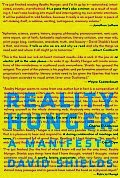
The death warrant for the novel always seems to be a celebration. Literary forms grow and transform over time; undeniably, the novel may be the most open, enigmatic and constantly challenging of forms. Why would there be a need to pronounce the novel dead if it wasn’t in fact alive and well? One rarely hears novelists proclaiming the end of the memoir, or the end of poetry.
In fact, so often people have a vehement dislike for and anger towards “the novel”--to which I often think: what did the novel ever do to you? Because it is a difficult form that defeats. Maybe what ultimately defeats is a lack of commercial success.
The benchmark of commercial viability is difficult to come by. Only a few books make it to the darling list. One of the results of this is the attempt to invent a new form. Another is to go meta.
Because the form has existed for so long, so effectively, and in light of technology, it seems viable to question the novel’s means and methods are no longer relevant or somehow wanting. Experimental writers take this up as a badge of honor, subverting narrative in the “traditional” sense (The failure to play the commercial game is to buck tradition, to deny what a marketing machine expects and searches for).
To identify a benchmark as baseline is usually the best most writers can wish for; then, to remain undaunted in the long haul of writing a novel, to say nothing of writing one of originality, is a meager dream. This might explain the proliferation of that type of novel that people supposedly want to read, the block buster, which is usually anti-original, formulaic, genre work.
To imagine that anyone is so in love with “reality” or aching for it, we have reality TV programming. But don’t imagine that those reality narratives aren’t shaped into some from of drama in the editing room (to lesser or greater effect--I’m willing to bet that among the writers on those programs is a novelist or two).
Without the anointment of commercial success, and having failed to live up to the demands of the form, so called re-invention is necessary. This is also known as a good career move.
David Shield’s Reality Hunger appropriates samples, sound bites, other writer’s pithy phrases out of context, and re-contextualizes them. He is utilizing the plagiaristic taboo writ large. This is the nature of the web having its influence on publishing. As with blogs, there is so much work to reference and draw from, to lead the reader to more and more information. One has to get read. The present horizon of the mobile text (the ephemeral written word on the web) means the writer can’t count on anyone getting that far into any one particular book. Yet Reality Hunger is a book, not an online text.
Reality Hunger as a text is a great idea. The style is a gimmick that provokes, seizing on the controversial aspects of recent memoir scandal (the appropriating element), as well as wrecking the house on the way out the door (the death of the novel element). But I won’t call it art.
Providing an antidote to an imagined problem is a proven marketing ploy, its effectiveness is a foregone conclusion once the publisher rallies behind it. Whatever the form of Reality Hunger is, it will never replace the novel.
Wednesday, March 17, 2010
Death Of Craft
There seems to be a lot of hand wringing and grief over the end of publishing in its traditional form. If you doubt you had a stake in it to begin with, it becomes easier to embrace the changes. I still don’t quite know what any of this means to me as a writer, but I’m worrying a lot less about what will come of it. And I’m glad to see that the book will never die. Maybe this should be considered the beginnings of a renaissance.
That writers can’t/won’t any longer make money from their work is considered inevitable. Journalism is becoming devalued. An untenable practice. The gist of this scenario is the fear that one’s work will become too easily copied, or reproduced (read: stolen) or worse still, evaporated into digital ether.
Rather than fret with Y2K type doomsaying, I’d rather see concern about craft. Until someone wants to read the work, fears of a plagiaristic public or “the end of cultural civilization” is off the radar.
I can see the day where craft might seem like it is no longer relevant. Is it wrong to say the writing is on the wall? (insert favorite mobile technology here.) There’s just too many voices clamoring to be heard (and voices here is as much the bloggorhea, the instant message which strains to be relevant). I trust I’m not alone in the dogged pursuit of craft. Even as much as the blog has an instantaneous thrill, I still insist thoughts committed to paper gestate before they appear here.
For all the immediacy of technology, the presumed benefit it offers an unheard of writer, I still avoid most of the technology whose expediency is largely useless to me. Had I had this technology available to me fifteen or twenty years ago, I think I would have been less wary, but I’m more interested in saying something useful or enlightening, rather than just chattering away on any old subject. I imagine that’s the case for a lot of writers who consider writing an art form.
On the optimistic side, the clamor is bolstered by the directives that getting published has become so commonplace as to be considered “easy.” But it’s not that easy. Not if you are trying to place your work where it might actually be read.
The all consuming needs of technology seemingly make it easier for more people to have a voice. The proliferation of voices implies there are more voices that want to be heard, and thus less with anything to say, or at least, less with any distinction. To which my immediate concern is an Orwellian death of craft. But the practice of writing has not been rolled under the bus. The tools of technology should not be imagined to have usurped craft.
I'll continue to be concerned with relevance, and craft. Relevance is in trying to get to truth, and to say what’s important. Being able to say that because it’s important to me, I trust it might also be for someone willing to read me.
Maybe this is the future, right here.
Tuesday, October 6, 2009
A Novel Detour
The reason for my absence from here: I’ve been working on a new novel, the first I’ve started since finishing my MFA three years ago. What I decided to do differently this time is largely about process, avoiding the pitfalls of my past forays into the novel. I think the MFA practice was useful because it forced me to think about producing writing, if not every day, at least weekly. My practice now is to write for at least one hour every day, usually in the morning. The goal is to produce at least two manuscript pages (or about 500 words), but on really productive days, I can write three times that amount. I find that the discipline, even in the face of limited inspiration, will yield results. After all, the daily production, since it is part of a larger piece, doesn’t necessarily have to make it into the novel. Since August 8th I’ve written perhaps 200 pages (The actual number is about 20,000 words per month; that’s two, fifty page legal pads per month--I’m just enough of a Luddite to write long hand). The ultimate goal is to produce a 100,000 word draft of the novel which I hope to have by the end of November. Then I’ll undertake the long effort of taking it apart, re-writing, re-shaping, and structuring the novel.
An hour per day. That’s it. I can work more on it if I want, but I often find I’ve said my piece in the bit of writing I did and I don’t want to force it. On some days, it is hard work, there is a feeling of forcing it. But sometimes even that bit of writing can lead to some new angle on character.
I came to this approach from writing short stories more or less religiously over the past three years. In my process for a short story, I came up with an interesting idea and explored it in writing. I wouldn’t usually rework the draft until I had a quantity (usually two or three thousand words, maybe more) to work with. I’m counting on this with the first draft of the novel. After a few weeks I find I’ve forgotten what I wrote a month ago, and I’m often surprised by where it takes me.
So much about being a writer is, like any job, “showing up”--I’m sure this sounds like the most obvious comment, but it’s true. You have to face the blank page every day and begin to put words down, however arduous, however difficult. What finally made me decide to work on a novel is that an interesting idea from a short story I had written suggested it, and once I began writing, a series of characters came to life. Once characters are in my head, they usually won’t go quietly.
Sunday, May 24, 2009
Must I Write?
There is something almost self-defeating and pointless to the idea of producing art for a market place. One must either already be established or they have to get established, taking some slow road to publication through journals or the proliferation of web outlets. Blind optimism and dogged determination are the factors that must reign because if you don't want complete obscurity, you need to try to fit yourself in.
I can be accused of hyping (maybe too often) the books that the major news media hypes, while generally overlooking the obscure, humbler publications that are put out by little known publishers. But on occasion, browsing a bookstore or a review site, I come across a work by accident and the writing to me is as original, interesting and compelling as the hyped one I set out looking for. I take heart in that. If the New York Times Book Review christens a book by making it the front page review, and everyone falls in line, that doesn't necessarily guarantee book sales or even that the book in question merits the attention--I always wonder about the back room machinations of those choices. Was it one top editor's favorite read that week or did the publisher promote it with enough advertising money to make it appealing? So many of these books then never catch on, so what does that author do?
Authors are inclined to have to do their own hype and marketing strategizing, whether they are in a featured NYT book review, or published by the Unknown press (I suppose self-publishing comes into this, too, although the lack of an extrinsic vetting process leaves me dubious about self-published writing). I can surmise that in the realm of promotion, at that point the writer probably simply wants people to pick up their book and read it. If there are only a handful of fiction writers making a living at their writing, what is the point of trying to do it? Well, I go back to my original motivation, and I feel like if it's art that you are creating, that can sustain you in and of itself. Maybe not. Still, I've decided to play the game but I keep my eye on why I'm doing it--it's that call that Rilke suggested in "Letters to a Young Poet":
"Go into yourself. Search for the reason that bids you write; find out whether it is spreading out its roots in the deepest places of your heart, acknowledge to yourself whether you would have to die if it were denied you to write. This above all--ask yourself in the stillest hour of your night: must I write?"
Writing in the web sphere, it's second nature for me to develop a constant stream of ideas about how to promote my work. For me, this is a combination of curiosity and fascination with this technological medium at my fingertips, but I recognize this can also be a huge resource drain. Yet I always remember when I didn't have this outlet, not so long ago. As distracting as it is, I keep it in check and have to pull back on occasion to remember my artistic calling and goals. I suppose if I had the publishing world clamoring to my work, I wouldn't get so caught up in the notion that I'm writing this and someone out there can read it if they like. Sometimes that's enough.
Tuesday, October 21, 2008
Residue Of Thinking
There is a level of purity, perhaps even idealization, in the art of fiction that conditions me to make it primary writing: fiction becomes sacrosanct. I would imagine a lot of fiction writers have this perception. The desire to express thoughts on any other writing can seem secondary, irrelevant, or too much of a distraction. In other words, if you aren’t writing fiction, you aren’t really writing.
Thus, I frequently find it necessary to justify the point of keeping a blog.
Just as in keeping a journal, a blog allows me to codify my thoughts, ones that may not be fully fleshed out. Here there is a compulsion to explain, perhaps to rationalize or discover the arrival at an opinion. When you work all the angles (or try), you may not avoid learning something new, or revising how you once thought about a topic or idea.
When I did my grad program writing, the process became most clear to me in the writing of annotations. The annotation is a more focused and detailed book reviewing, usually of a novel, although one can annotate any book. The discoveries came out almost organically from the material, as opposed to trying to validate a premise, a shortcoming of many of my so-called “academic” papers. The writing came to be what I called thinking on the page. It’s what writing is for me: ultimately a conveyor of thought, but essentially a residue of thinking. Through the writing I am discovering. But the goal isn’t necessarily about achieving objectivity, something that I feel inclined towards when writing a book review, if only to appease an editor. In general, objectivity will drive everyone toward safe, not unreasonable conclusions, or what will avoid being unpopular or controversial. But what has more interested me may be the illusion that what I’m driving at is highly unique and subjective. Abandoning politics, right thinking, trying to please any master other than myself, in short, avoiding playing it safe with my conclusions, is what this blog writing feels like to me.
The blogs I’ve come across run the gamut. There is the tightly braided academic language that uses jargon and excessive complexity to state something simple, possibly to cloak an idea the writer isn’t quite sure of. On the other end of the spectrum is the palatable to all, I-don’t-want-to-offend-thee pablum that is merely a form of soft self-hype, of little substance. I suppose I’m holding my own style up as an ideal counter-example.
My version of a blog is an attempt to subvert the spontaneity of execution that is blog writing. Maybe this is an anti-blog. I don’t just write the first thing that comes to me here--I don’t want to be that boring--nor can I be (dare I say it) eloquent without reflection. Andrew Sullivan’s piece in the Atlantic first got me thinking about all of this, as he seems to aim at justifying and defining the “proper” use of a blog. To which I offer: why deny what a blog can be?
Subscribe to:
Posts (Atom)