Thursday, November 12, 2015
Bringing Secondary Characters to Life
Tuesday, June 2, 2015
The Life of Reading
Wednesday, August 13, 2014
The Second Inaugural Meeting of the Karl Ove Knausgaard Society

Wednesday, July 16, 2014
The Li(n)e Between Truth and Invention in Fiction
Sunday, October 6, 2013
Double Barrels: Political Humor and a Double Review
Wednesday, November 7, 2012
One Star Reviews
Wednesday, August 8, 2012
Hate This Book!
Wednesday, June 20, 2012
Insistence On Persistence
Monday, December 12, 2011
Not Just Another . . .

. . . 9/11 memoir, or is it? “The innocuous premise establishes There’s a Road to Everywhere Except Where You Came From, Bryan Charles’s atypical survivor memoir, is the classic struggle of a fledgling writer pursuing his dreams to New York City, and rife are the pains that accompany that pivotal confrontation with one’s future life of work. But there’s something more devastating in the memoir, told almost incidentally, in terse, and at times white-knuckle prose.” Read my full review in the latest Rain Taxi, available here.
Wednesday, October 26, 2011
Reading Geoff Dyer
The essays in Otherwise Known as the Human Condition often seem fired off with the effortlessness of a pool shark making clever bank shots. Elusively show-offy, though also using a self-effacing sleight of hand, Geoff Dyer has made his own genre of personal essay, keeping the reader engaged the same way as someone very interesting at a party. This is a writer’s trick, a necessity, and a boon, to be continuously interesting. It’s hard not to find Dyer’s voice appealing.
Dyer’s style feels sprung in one sitting--and that’s not bad, if anything, you feel envious for how easily he cuts loose. In Dyer’s work, there is a feeling of the pre-emptive, that he’s writing in this manner for when someone decides to scrutinize it. Having what appears as a “loose” style might be an excuse for avoiding explaining that one is in fact more rigorous than they seem. There's something appealing about Dyer's attitude, which is a kind of hands off, You can't hold me accountable for being so freewheeling. But there is a danger with the encomium, which is what Dyer resorts to most often in his essays: too much praise can smell sickeningly sweet.
Does the ability to write whatever one wants, as breezily as it seems to flow from the pen, then become in danger of sacrificing rigor and putting the ego on display? It feels like Dyer toes this line where a certain amount of reigning oneself in is necessary. Yet if your writing is consistently entertaining, you must have an innate understanding of how far you are willing to go before you embarrass yourself. Sure, it's simple, leave those parts out. But Dyer might be the writer he is for the ability to leave those parts in.
Dyer claims a boredom with the quotidian, which is only doubted by his apparent enthusiasm and engagement with his material: literature, music, photographs. The collection is divided into five essay categories to reflect this broad range of everyman, John Berger-esque interest.
Dyer’s assessment of The Great Gatsby, for example “[...] the writing in these pages is strikingly inept”, may be the opinion of many who have gone back to reread that acclaimed classic, but only Dyer gets away with saying it, perhaps because his tone is good-natured--besides, how can he pick a fight with the dead? Dyer’s interpretation requires him to re-read Fitzgerald and assess from different periods of his life of reading him. This almost doesn’t seem worth the trouble with many beloved classics, because after awhile one loses interest in revisiting writers they’ve already spent more than their fair share of time in the attempt to disprove prejudiced negative opinions. But you can be glad Dyer makes the effort. That Dyer returns to a historical fiction is intriguing, and it makes one realize that Fitzgerald, who hasn’t yet fallen out of the canon, is surely teetering on the edge.
When it comes to writing about music, primarily jazz, Dyer the enthusiast can drown out the music with his history of listening, perhaps without adding anything substantial to our understanding. When Dyer mentions the same obscure ECM jazz recordings (in three separate pieces in the collection!), and attempts to answer the question, "Is jazz dead?", the reader suspects enthusiasm has trumped authority. So heavily larded is Dyer’s playlist with Keith Jarrett, that he stretches his credibility to the point where the reader is numbed to the praise. Also, there are Dyer’s silly statements, witty though they may have been in the composition: "The history of jazz has been the history of people picking themselves off the floor." What that means, I'm not sure, and the tone is Dyer imitating Amis, which happens intermittently, here.
Though you can see why Dyer is drawn to the photographers William Gedney, and Miroslav Tichy, artists who improvised and never quite finished what they started or were committed to it long enough to be taken as masters of their art. Tichy seems to have become an artist in spite of his intentions, which have more to do with satisfying prurient urges (he took stalker-ish telephoto shots of women on home made cameras). And he has the outsider position of a Henry Darger, without the discipline. Gedney was always starting a writing project, though it seems it was ultimately easier to mess around behind the camera than to write.
As for his interest in photography, I impatiently read this section (“Visuals”) and wondered why it’s one quarter of the book, and why it’s the front end. My sense is that Dyer is so enthusiastically drawn to photographs and their explication, but without a slew of examples, it isn’t always clear what he’s talking about. And thus, some of Dyer’s pronouncements seem unearned, even overstated. It might be a great niche for Dyer to be a student of photography, but his airy interpretations, no matter how much they are accurate and true for the author, they don’t add to my knowledge or interest as a reader.
Dyer is preoccupied with Americanness and specifically, with the fixation of American writers on the novel; though as a writer of novels, and an outsider, British, he obviously, also has the fixation. Dyer highlights the particularly American phenomenon of how writers aren't taken seriously unless they are heavy hitting novelists. He also works this idea into a discussion of Iraq war memoirs and a perception of the damning strait-jacket of British class distinctions for prose writing. And his critical, yet somehow still praising, take on Susan Sontag, in response to the proclamation she made for herself as a "storyteller", boils down to what discerning readers of Sontag may think: "To put the matter crassly, Sontag couldn't tell a story to save her life." Dyer has a penchant for going after the dead.
You often hear these arguments from a less than successful novelist (Dyer) who has made a name for himself as an essayist (I hesitate to say, critic). The novel is held up for canonization in the history of letters because fiction is the ultimate entertainment--soothing medicine--to make readers forget the pain of reality. Or it allows them the comfort of wallowing, from a safe distance, in someone else’s misery. Writers want to be in that canon--or it's the fastest way, one viable way, into possible posterity. No matter that the works there are often merely popular long before they would ever be praised as literature. Dyer gets this point, and rails about it a few times, and then you can sense he recognizes that he's established his foothold at least in the current readership of non-fiction.
Friday, May 13, 2011
Spouting Edifying Brilliance
The work ethic is close to the one of craft. In the Midwest, where I’m from, it’s hard to escape the notion that you can't get anywhere unless you are willing to work hard at it. As much as I’d occasionally like to believe in innate genius, I no longer think there are so many of them walking around spouting edifying brilliance fully formed. If anything is lacking from the discussion of what makes for brilliant writers, it’s really about how hard they have had to work to get there. Craft, being tied to the notion of work and sweat, probably gets a sniff once in awhile from the unjustifiably entitled, and yet, at the risk of sounding utterly un-hip and downright backwater patriotic, I think hard work is one of the only true legacies of this country’s striving and success. (Granted, capitalism has thrived on this exploitation, but perhaps you get my drift.) Thus, it’s not surprising that an outsider would disdain this humble legacy that has helped foster the MFA program proliferation in the U.S. This is all a long way of saying that I really love and applaud Mark McGurl’s take down of Elif Batuman’s critique of his book, The Program Era: Postwar Fiction and the Rise of Creative Writing.
Thursday, May 12, 2011
West of Here

My review of Jonathan Evison’s West of Here is due in the forthcoming issue of Rain Taxi: “Bearing the hallmarks of an epic yarn, the novel boasts frontier exploits, Native American mysticism, Bigfoot, and an environmental cause wound into its myriad character stories.” Further, the novel manages to ask if a group of industrious settlers can be a detriment to the well-being of their descendants. Sound like a stretch? Read my review of this engrossing and immensely entertaining epic.
The print issue of Rain Taxi (Vol. 16 No.2, Summer 2011 (#62)) is available now.
Thursday, January 20, 2011
Cheese Pizza Effect
Sunday, January 2, 2011
Memorable Nonfiction 2010
Reading feeds the desire to write, and writing in itself is often an extension of reading. This explains why I read novels above most other works. Since I read so few biographies, memoirs, essay collections, and letters, I’m more selective, though maybe I ask of these works the same thing I ask of novels: that they feed my thinking and get me motivated to write. Three non-fiction books stood out for me this year.
The best biographers give you the life complete, baggage and all, written with no distracting bones to pick with their subject. The biographer takes on the self-erasing task of subsuming themselves in the life story, and sifting through the expected mundanity in order to reveal the exceptional. This could be difficult to accomplish for anyone compelled by their subject and trying to interpret the life, yet a degree of fandom is essential, as well as restraint. One of the best literary biographies for having covered this ground, and yet not shying away from either critical assessment, or candid and sometimes difficult judgment, is Blake Bailey’s Cheever: A Life. Though I was mostly a casual reader of Cheever’s well-known short stories before I picked this bio up, I came to admire the conflicted writer who, at heart, made a unique and solitary venture of his fictional output over a long and sometimes troubled life. This reading sent me to Cheever’s overshadowed novels.

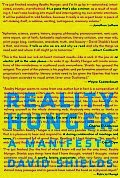
David Shield’s Reality Hunger: A Manifesto had me riffing on its provocations. Like any good book of philosophy, this one forces a reader’s reaction. The numbered paragraphs are widely borrowed from attributed sources and compiled to construct a number of dubious arguments (the novel is dead, “sampling” is the future of literature, truth is more worthwhile than fiction). Nevertheless, the resulting compendium is provocative for the daring of the broad sampling ( a preponderance for several quotable essayists), often rewritten to make Shield’s points, which proves or at least validates that his de-contextualization experiment might just be a hybrid form of memoir-slash-manifesto. Though it also provides a convincing case that the novel is alive enough to provoke diatribes against it.

The Letters of Samuel Beckett, 1929-1940, are almost too specific, direct and intimate, like catching one side of an eavesdropped conversation, that a guilty taste of voyeurism is unavoidable. What comes through the young Beckett’s missives is a hubristic certainty, a kind of unassailable arrogance, as well as an authority tempered by doubt and perseverance, as when he declaims to his cousin Morris Sinclair: “Here I strut about, I cannot and will not do otherwise, and have no idea if God helps me or not.” One would have been honored and maybe intimidated to have received from Beckett a multi-lingual letter laced with multiple literary references. But even a partially committed Beckett completist will be curious to thumb through this first of four projected volumes for prime examples of an endangered, if not yet extinct, form of writing from a modern master.
Friday, May 28, 2010
Boxing The Demons
The tradition of maligning short fiction could have begun with John Cheever, following one of his early and persistent influences, Hemingway, though Hemingway might not have made a distinction between novels and stories as greater and lesser forms. In Blake Bailey’s expansive biography Cheever: A Life, it is apparent that Cheever thought writing short stories for the New Yorker year after year was not a worthy path for a serious writer. Yet a handful of his stories seem to have changed the fiction terrain forever after. In the cult of fiction hegemony, it’s sometimes difficult to separate the writer from their mythology, making them superhuman. All the easier if they’re dead. The man who writes his every naked personal desire and whim in his copious journals (published posthumously), and produces an estimable body of work (the stories, numbering in the hundreds, and five novels), is surprisingly humanized when the veneer is stripped away.
It’s as if with Cheever, the themes--family, middle class livelihood, the desire for love, the lift of grace--never changed, and though he turned out sublime stories in “The Swimmer” and “Goodbye, My Brother,” knowing how long he struggled with the first novel, it was clear the major struggle, the ultimate performance, was going to be in a sustained work. The short story becomes a kind of trial run, a small performance.
Here, in Cheever’s first novel, The Wapshot Chronicle, is Rosalie, the young boarder at the Wapshot’s house, ruminating on thoughts of her date’s “secretive life”:
The thought of the picnic hamper reminded her of his plain, white-haired mother, who would have sent along something of herself in the basket--watchful, never disapproving, but saddened by the pleasures of her only son. He had his way. His neat, bleak and ugly bedroom was the axis of their house and the rapport between this man and his parents was so intense and tacit that it seemed secretive to Rosalie. Every room was dominated by souvenirs of his growth; guns, golf clubs, trophies from schools and camps and on the piano some music he had practiced ten years ago. The cool house and his contrite parents were strange to Rosalie and she thought that his white shirt that morning smelled of the yellow varnished floors where he took up his secretive life with Ma and Pa.
The prose signals the inner life of a woman who herself has secrets, and has not yet arrived into full self-possession. Mildly glum and resigned, Rosalie sees herself, too, in what she observes. The reader senses Cheever’s compassionate understanding of his character and a desire to reveal her beating heart.
Cheever was committed to the novel as an art form. He was not merely distancing himself in a kind of performance, which short stories really can be, and many novels simply are. In a literary novel, one gets a sense of who the writer is; it’s as if one gets an insight on the ruthlessness of the writer’s psyche.
The writer's sensibility is ever dominant in the biography, but it’s not just honesty, and not only brutal honesty (which would aim to call others on their shit but not necessarily to face it within oneself--a quality popularly known as “self-denial”). This sharpened sense of the interior life of one’s characters comes from first hand knowledge.
Cheever, who fueled himself on gin, whisky, and an unusual amount of self-loathing coupled with a genuine dog-like (dogged?) loyalty to loved ones, is initially conveyed to have the charm of a genial drunk. A self-destructiveness in Cheever’s journey comes in, maybe as more of a passive self-annihilation, through alcoholism. I couldn’t help but think on many occasions, “What a sad, miserable life.” Yet his life had its joys, too.
A writer who cannot transform their torments, or cannot get far enough past the source to risk a possibility for some more contented life, is trapped perhaps by their own image and expectations. Cheever is frequently characterized as a narcissist--the tragedy in such a figure is that they are their own worst enemy. They can never fully lift themselves up; there is no solid source within. Life has to be reconstituted incessantly from the next ego stroke. This is the forest for the trees analogy: one cannot see the world from staring at their own life for so long. Yet the ability to draw from life seems to be a therapy, too.
In trying to understand what draws me to novels that have a gravity, perhaps honesty is the prevalent quality: emotional, psychological, and spiritual. Maybe it’s as accurate to say, this is the writerly aspiration, or should be; what one should want to project in the best of their work. It’s the built-in bull-shit detector not even simply to oneself, which is where Hemingway’s seems to have short circuited; Hemingway was perpetually boxing his demons (in both senses of the word). The result is often transparent: retarded self-defensiveness posing as confidence, otherwise known as machismo. For Cheever, boxing his demons was more like having this box in an attic room where he could occasionally look in on it with cautious surprise and curious wonder.
Cheever’s struggles were not just something he could write himself out of, nor like so many celebrated writers who have followed him, was he satisfied with intellectualizing the grist for his mill (which is, ironically, perhaps an effort at self-preservation). The Wapshot Chronicle reveals he had the wisdom to acknowledge this, while reinforcing the complexity that centered him. This flawed human being, however tragic, was able to get his hands around the heart.
Friday, April 23, 2010
Feast Of Excess
There is a notion that a novel has to be as healthy and bland as kale or else it isn’t literature. As if the unspoken rule is that it must only be sternly serious and if it happens to be enjoyable, then that must be an oversight on the writer’s part. This seems to be the root of a lot of the criticism of Ian Mc Ewan’s Solar, for what it is not.
That Mc Ewan’s novels are elaborately constructed marvels of prose and entertaining is a testament to his skill. (This could be lost on this NYTimes book reviewer.) If Solar does not reach the same high watermark that everyone was expecting after Atonement or On Chesil Beach, the writing is the epitome of Mc Ewan’s stylistic precision. Still, Mc Ewan is going for a laugh any time he describes a glutton’s eagerly anticipated meal:
“She took away the bowl with the three cold lozenges and set the main course down before him. Four wedges of skinless chicken breast interleaved with three minute steaks, the whole wrapped in bacon, with a honey and cheese topping, and served with twice-roasted jacket potatoes already impregnated with butter and cream cheese.”
Solar is an indulgent feast of satire.
Solar harkens back to the style of Amsterdam, operating in a comedic-tragic register which also recalls the bold mischief of Mc Ewan's early short stories. There, the characters are young and depraved, making sense of the world from a limited understanding of it. What those life lessons earn the protagonist of Solar, Michael Beard, is a deficit; forever after he will go to extremes to avoid humiliation at the hands of an associate, using whatever vengeance at his means, getting away with whatever he can. Youthful curiosity and glory is eventually replaced with the fading returns of post-middle-age survival. Beard isn’t a character easy to like, but he seems prototypically human, and it is as easy to laugh at him as it is to have hope for him in his failings.
Mc Ewan wallows in Beard’s excesses. This is the opposite of the life-saving and affirming protagonist in Saturday; Beard is a man who on the face of his accomplishments (Nobel Prize winning physicist) might be enviable, but is flailing with a dangerous lack of scruples. Maybe the degree to which a reader is willing to follow this reprehensible character is how much he or she recognizes the folly of human endeavor.
Self-consciousness drives Mc Ewan’s protagonists; he has consistently perfected the limited third person point of view, or, as James Wood has it, free indirect style. In particular, this consciousness allows Mc Ewan to confront moral quandary and force the character to interact with their world on a finite scale. The depth of this consciousness can be almost uncomfortably perverse and unbridled, backed up by the scientific mind that allows Mc Ewan to focus in on the protagonist’s whims with a dissecting knife. That this consciousness is rendered in more depth and literary-ness than the person having the experience would probably have is playing to the satire.
The rendering of Beard’s gluttony is anachronistic, almost indecent details applied to a novel of a lofty and timely subject (Global warming). The effect is ornate overstatement, words larded on because Mc Ewan can, that feels defiant--in a sense, he’s showing off--but it’s a sure-footed, often hilarious, touch.
Much of the narrative of Solar relies too readily on the withholding of information. In a more high minded work it might be considered manipulative, but this is light treatment of a heavy topic. The problem for Mc Ewan is taking a subject too earnestly and becoming heavy-handed, bogged down in technical jargon and plot machinations as he did in Saturday. In Solar, he applies his research to make the stakes relevant, though the reader may find that these stakes are largely misconstrued. Beard is the center of his own universe.
Solar begins tentatively, with a back-story summary, though this exposition provides signposts for the novel’s departures. If a novel is a journey, there are enough clues from Mc Ewan that the reader will be taken on an adventure. And ultimately, Solar achieves what a novel should, engaging the reader in a world that suspends in wonder, be that wonder at the skill of the writer, or at the anticipatory pleasure of what is to come. The repast can be a feast to binge on, or a satisfying meal to savor. It’s all good.
Thursday, April 8, 2010
Reality Hunger's Discontent
Because the form has existed for so long, so effectively, and in light of technology, it seems viable to question the novel’s means and methods are no longer relevant or somehow wanting. Experimental writers take this up as a badge of honor, subverting narrative in the “traditional” sense (The failure to play the commercial game is to buck tradition, to deny what a marketing machine expects and searches for).
To identify a benchmark as baseline is usually the best most writers can wish for; then, to remain undaunted in the long haul of writing a novel, to say nothing of writing one of originality, is a meager dream. This might explain the proliferation of that type of novel that people supposedly want to read, the block buster, which is usually anti-original, formulaic, genre work.
To imagine that anyone is so in love with “reality” or aching for it, we have reality TV programming. But don’t imagine that those reality narratives aren’t shaped into some from of drama in the editing room (to lesser or greater effect--I’m willing to bet that among the writers on those programs is a novelist or two).
Without the anointment of commercial success, and having failed to live up to the demands of the form, so called re-invention is necessary. This is also known as a good career move.
David Shield’s Reality Hunger appropriates samples, sound bites, other writer’s pithy phrases out of context, and re-contextualizes them. He is utilizing the plagiaristic taboo writ large. This is the nature of the web having its influence on publishing. As with blogs, there is so much work to reference and draw from, to lead the reader to more and more information. One has to get read. The present horizon of the mobile text (the ephemeral written word on the web) means the writer can’t count on anyone getting that far into any one particular book. Yet Reality Hunger is a book, not an online text.
Reality Hunger as a text is a great idea. The style is a gimmick that provokes, seizing on the controversial aspects of recent memoir scandal (the appropriating element), as well as wrecking the house on the way out the door (the death of the novel element). But I won’t call it art.
Providing an antidote to an imagined problem is a proven marketing ploy, its effectiveness is a foregone conclusion once the publisher rallies behind it. Whatever the form of Reality Hunger is, it will never replace the novel.