I often consider the notion that we write because we’re trying to bridge a gap of connection to others.
Before I had ever published, I longed for a community as if this would legitimize me as a writer. But even as I craved connection, I was wary of demands and expectations put on me, for example, if I took a writing class, or let an editor touch my work. All of which happened in due time, though not before I would let myself get burned, as I saw it. Hastily, I dropped classes before I could even know the name of a fellow student, and I cut off contact with an editor who was simply doing his job.
Writers seem to be everywhere, particularly where I live, in the Bay Area, and I have taken it for granted that I should be part of a writing community. Yet I have never been able to find a long standing, mutually beneficial community.
I would have liked to have established this writing community in grad school, but as much as I made the effort, it did not happen. I went to a low residency program, and it’s been difficult to maintain connections with my colleagues over the years. I seem to befriend people who, due to whatever exigencies of life, gave up their writing dreams, unlike me.
I’m not talking about a writer’s group, per se. I’ve been involved in these over the years, and I rarely find writers who are as serious and committed to writing as I am.
I have some writer acquaintances, but they are mostly long distance email connections (an editor on the east coast who liked my work; a writer in Los Angeles whose work I follow). In fact, when I communicate with other writers, it’s usually through the internet.
Possibly true, not entirely benign assumption: Writers who have established themselves don’t want anything to do with writers who have yet to establish themselves. And I, having established myself in my own way, don’t want to waste time with writers who aren’t at least as established as I am. And in reality, aren’t all writers established in their own ways?
I think not having a writing community might come down to my own resistance. I’ve always believed myself to be an outsider; I don’t feel entirely comfortable in any group. To be embraced by a group, is, for me, to be an imposter. If I were more active in the local community, it seems that I might meet more serious writers like myself. My loner status may be a way for me to actually do the work of writing, since I don’t have the distraction of people talking to me about their work.
I can see that it’s easy to suggest that I’m complaining about the ability to find a thing I want nothing to do with. But what if I just accept that this all embracing writing community is a fantasy?
In the lack an actual writing community, I believe publishing keeps me in the writing world, though it is essentially a virtual world. I think the privilege of publishing gives me a voice, and maybe, in my own uncharacteristic perception, this gives me a community. I may still long for that community connection, but I’m content at least to have my writing practice rewarded by occasional recognition.
Writing, as primary as it is to my life, of necessity comes after everything else (I’ve got a job, and a family that demands much of my time). But this doesn’t diminish writing’s vital importance to me.
Most of my friends and family know that I write, but I suspect few of them have read my work. This is possibly because I’m uncomfortable foisting it upon them, but it may just be that they are uncomfortable reading it--or, if they have read it, they probably wouldn’t talk about it. (I’m from the Midwest, where it’s not polite to make overtures about yourself). So it doesn’t come up. I think that if they are interested, they know where to find my work.
In my early adolescence, I struggled with feelings of inferiority and self-consciousness. I developed the notion that I would have to strive to do some (or many) things better than the average person. The habit has stayed with me; I’ve always worked hard on my creative work, possibly as overcompensation. My manner of coping, of overcoming, has been working on projects.
What these early struggles did was to allow me to discover my creativity, to go inward and cultivate a craft, and a knowledge base, that is invaluable. Writing has ultimately been an exploration into understanding myself. That I have gained this and found little of the community I once longed for--and expected--often feels like an acceptable trade-off.
Showing posts with label technology. Show all posts
Showing posts with label technology. Show all posts
Wednesday, May 10, 2017


Sunday, January 8, 2017
On the Future (Further) Intersection of Technology and Literature
One form of literature, at least the one that thrives through publishing on the internet, has been transformed by the internet. I’m talking about short fiction, the kind that is most amenable to the attention spans of individuals who use electronic devices. This is one way that we could posit that technology has made an impact on literature. This literature, in fact, is most often where the cutting edge appears because it’s not produced and hashed out by a marketing team.
What does the future of cutting edge literature look like? It’s not in traditional books, or rather, it’s no longer necessary for books to exist in order to present it.
I’m of a generation of writers who are almost a “creation” of the web. Of course, the web did not create me, but if it did go away, so would go away--at least in the digital ether--much of what I consider to be my best and most important work. Essentially, my work came of age with the web. Or I came of age when the internet did. I don’t know if I could conceive of the writing path that I’ve taken in the last fifteen years or so in any other way.
If you consider technology to be indispensable, maybe you ask that question, what if the internet goes away? On the one hand, there are those who believe it’s foolish to have any investment in the web (they shun having their work published there; they either can afford to, because they are safely ensconced in legacy publishing, or they don’t care about the web, consider it a fad or whatever, and maybe they do or do not use it as a tool, etc.), and on another extreme are those I would call the immersives who believe anything is possible, for example, that the web could evolve to the point of spontaneously producing intelligence. (If you think I’m grasping here, just watch this clip from Werner Herzog’s Lo and Behold: Reveries of the Connected World) The web, and its inherent potential, is essentially out of our hands. It is uncontrollable.
If the internet vanished, there are still the people who have created the work, they will create more, and there will be new creators to come. Are we “dependent” on it like life support, or is it rather that we don’t--and can’t--imagine it going away? And even if the internet did vanish, something new would be created to replace it, probably Web 2.0.
To look at the changes that technology has wrought to publishing over just a few years: new ways of marketing, and more venues for one to promote themselves--these tactics can seem merely superficial. On the other hand, the broad reach and availability of these tools has made the web pervasive. What is significant is the impact of the web and its potential to reflect a zeitgeist. An arguable point is that the web has only become more essential, more necessary. For those firmly entrenched in legacy publishing, the internet is a supplement, if it’s not a foregone conclusion by virtue of what it lacks in relation to traditional print publishing. Equally, print might seem irrelevant to a lot of techies.

Again, no matter what changes and developments come, as far as the web and publishing, technology will always bring something new. Because we are constantly working within the technology, it is bound to change; technology constantly evolves. It is almost a “live” organism, in this sense. Whereas there have been no major innovations in the basic technology of the printed book for thousands of years.
In some sense, even writing is static. But perhaps the capacity of the creative minds that produce literature is a realm that is unpredictable, with a potential that we might never fully understand enough to have the capacity to reach. And this touches on notions of artificial intelligence creating a kind of literature. Such expectations I think are still beyond viable; it ultimately takes a human mind to craft the narratives and imbue the poetry of language with the lyricism that humans can grasp.
Since the dawn of the internet, every social media company with a significant financial stake in it has been trying to figure out how to monetize the web; the only way--or the main way--is subscriptions and advertising. If you put any intellectual content out there, you try to monetize it. Those producing it may not have a significant or pressing financial relationship to it. People may not feel obligated to pay for something they can ultimately get for free. This puts someone like me at a disadvantage. My options would seem to be to get into more paying venues. But the truth is that I’m not going to stop writing because no one is paying me.
No matter what speed technology can provide for the processing of data, reading and writing occur at a relatively slow pace, which is more or less fixed. It’s the same as it was 100 years ago, or as it was 500 years ago, and further. Could this convince us that book technology won’t change for a long time, if ever?
The book, in some form, has been around for thousands of years. The computer, the tablet, et al, for less than a few decades. None of these advances have changed the book. Writing is a quiet and ancient technology in contrast to all pervasive technology as we know it. The change for writers, if they choose to utilize it, occurs mainly in the means of putting the work out there. The book is a relatively stable artifact. If we consider the futurist thinking of far flung possibility, maybe at some point a chip or device planted in the brain will allow access to all books. Then you’ll never need to read a book, you will have vague memories and knowledge of having already read it. Or you will be able to access it from the cloud you plug in to your brain. But even this won’t really change the way the literature that it contains is created. Someone still has to write the literature.
(Photo by Kyle Bean "The Future of Books" website, here.)
Sunday, October 30, 2016
The Inward Gaze (Part I), and “My Dinner With Andre”
The position Andre takes in My Dinner with Andre is a despondent one of privilege. He’s so conscious of his despair that it seems a thing of study, a project, and he comes off much like a maudlin Woody Allen character. Wally points this out to Andre, but in the process he becomes almost strident, and defensive, while Andre maintains a cool unflappability. For all of his despair--and outrageous experiences that verge on the implausible--Andre is the one we are meant to perceive as a sage. (Let me just say up front--I have always loved this film.)
 The movie has much to say about the evils of capitalism, which, by virtue of its obviousness, you might think yourself crass to not immediately drop everything to go trek into the woods to live. This critique of capitalism is a position I am familiar with, and have found indispensable at certain periods of my youth. Yet seeing how entrenched society is, I have come to resist my old railing against the system in favor of the inward look, the solace of, for lack of a better notion, poetry (not poetry explicitly, but poetics, perhaps, the search for apt words, the struggle to speak, to articulate; this does include poetry, of course).
Brian Eno believes it is all inside of us--by which he means god or the divine, as does Jung (“...who looks inside, awakens.”), and I want to agree. It’s that which I give to myself that grows rich and spends me (Rilke). I don’t know when, or if, I have ever really had to go looking outside of my own passionate engagement with my creativity in search of something, an answer, a cure-all--though I’m sure I’ve made the effort; particularly when it was asked of me. Or expected.
Is the inward gaze an apt countermeasure to the perceived evils of our technologically driven society, or is it akin to apathy? I worry this attitude might be false contentment, or cold comfort: the world is going to pieces while I’m navel gazing. I recall a friend pulling the phrase out (“cold comfort”) in a way that made me think he was a tourist observing his own neurotic tendencies, as he seemed to have a new diagnosis every few weeks or so. This, again, is the privilege of the intellectual, the social commentator, the crank--the Luddite? That’s what I sense from Andre in the movie, that his despair is a pose bundled into a convenient cultural criticism that allows him to be clever, and self-regarding about his diagnosis.
For many of us, I suspect, observation and comment can seem like the only and main comfort. Is this any different than tweeting or sending text messages to cohorts? Is the resort to social media a quick fix--is the careful delineation of thoughts posted for an unknown audience in any way approximate to the inward gaze? Maybe only in terms of one being private, while the latter is public. The use of social media is often only a quick fix. It’s often merely reactionary.
To my own argument I’ll say, my expositions here don’t require the jittery feedback of an immediate response. My work is more on the slow burn of accumulating thought. I’m not looking to deaden my senses; the work I do is to awaken myself to the possibilities inherent in language. I consciously make the choices I do with my time. These activities are, to me, not escapes; of course, I can conjure the voice of an Andre saying, “You do not see them as this, but that’s what they are.”
I consider the plight of Andrew Sullivan, who laments his dependence on technology in a recent New York magazine, and imagine that for him, what he complains about is actually his bliss: his mind being sapped for a constant hit of dopamine. How is my presumptive bliss--this, writing, reading--any different? Isn’t the loss of our mind to a fictional world for hours at a time no less of a concern?
I think back to Mihaly Csikszentmialyhi’s essential book, Flow, which first established for me the importance of maintaining that inward gaze. There’s a popular class at Stanford, and now a book (Designing Your Life: How to Build a Well-Lived, Joyful Life), in which the authors have utilized these concepts to help people figure out their true calling in life. Frequently, I try and fail to find flow in my work, but I’m not going to trade in the search to follow some daily stream of nonsense on a screen. I don’t have a smartphone to keep myself entertained. (Not to seem too virtuous, but I do have periods of my youth spent at mindless screens (video games), and later, mini-web rabbit hole searches; but I always resurfaced, and never stayed with these activities for long). Maybe this is the key to flow: ultimately, I find my own creative process more stimulating and satisfying than the soporific feed of the web.
I’m aware of how lucky I am. Maybe my concern be more of a concern for my fellow men, who may not have the same wherewithal. I tend to presume that everyone has enough self-restraint to wise up and take care of themselves to put their devices away when the muse beckons; I can’t complain about a lack of willpower.
In My Dinner With Andre, Wally reckons with the panic that he can’t still his mind--this film was made in 1982, long before we became immersed in the web 24-7, so this is prescient--and for a lot of technology junkies, a moment of quiet within one’s own mind is a difficult breach, possibly far more dreadful than anything imaginable. I believe I know this fear, also, but if anything have learned how to turn it into a tool for my writing; indeed, I think it’s the only way writing gets done.
What if this condition of the unquiet mind is as rampant as it seems to be, or we are led to believe? I sometimes suspect it is far worse than I can imagine; that the mass of men (and women) really do live lives of quiet desperation. Maybe this is the present form of quiet desperation: the immersion of our devices, another app. Is this why it can seem that people turn to technology for the next quick fix, much the way Andre goes hopping among pseudo mystical retreats in search of an answer?
I try not to imagine a bleak technological future, and maybe I’ve convinced myself that I remain at a safe, self-imposed remove. I neither feel a need to shout among the train riders engrossed in their devices, nor do I salivate for the next gadget.
Thursday, October 8, 2015
Roth’s First Person Point of View in Operation Shylock
I find that, in spite of my own sage advice to myself, I am working on a first person novel again. John Gardner, in The Art of Fiction, says “In any long fiction, Henry James remarked, use of the first person point of view is barbaric.” And yet, if this is the case, we don’t seem to lack for first person point of view novels, I’d venture far too many to count since the beginning of time. Is there something inherently apt for our technological times that lends itself to first person?
One of the reasons I’ve avoided first person in a novel is that it always feels too limiting being locked into one character for several hundred pages. My inclination is to always want to go big, broad, reach for a larger perspective, something more readily done in omniscient or third person (the all knowing, all seeing and indifferent God paring his nails.) It’s interesting that in many reviews, point of view barely gets discussed, but it’s impact is fundamental, and inextricable--though saying this sounds ridiculously obvious. Nothing has more effect on character than its being written in first person. First person is character.
I think the challenge for a novelist writing in first person--or one of them--is that unless you’ve got a compelling voice for this character, you are at a disadvantage. First person requires an extended performance. In a sense, the narrative never drops out of that register, and thus, it becomes difficult to reveal the other characters except from one specious point of view, which may (will be) biased, critical, and short sighted. The ancillary or secondary characters don’t get an equal hearing, unless your first person narrator can be entirely magnanimous. Or these characters have to become first person narrators, too. This is also a strategy, though I think the difficulty would then be how to distinguish one narrator from the next. But this doesn’t seem thematically what I want from a novel, though of course anything is possible. It’s an egalitarian point of view structure that favors one voice, which opens it up to being one-sided, lacking in complexity.

Roth, to my brief survey, has evaded these problems using first person masterfully in Operation Shylock, and thus reveals why and how it is a viable point of view--challenging, but worth trying to pull off. Or at least trying to learn from Roth.
According to Claudia Roth Pierpont in her biography Roth Unbound, of the writing of Operation Shylock, Roth said: “I felt like I was dancing as a writer.” It shows.
From the start this novel heightens complexity, not in the least by using a double, an imposter (supposedly) of the character Philip Roth. This forces Roth’s first person to challenge him by posturing himself as someone else in confronting the imposter, which reveals another way out of the first person dilemma, dialogue, which creates an immediate, unavoidable tension. This provides for brilliant conversation in which, apparently straightforwardly, the Roth imposter presents his views on Diasporism, to which character Roth can respond, incredulously, vehemently. This is wonderful, inventive satire. (And Roth makes it look easy; as well, he does this so beautifully that it is inspiring.) The doubling even extends to the character of John Demjanjuk--”So there he was--or wasn’t.” Even the possibility of uncertainty hangs over his identity as a Nazi camp guard.
In Operation Shylock, Roth complicates what could merely be simple. With Roth, we’re always being poked narratively far deeper into even the most mundane surface (this is rather euphemistically, being pushed deeper into shit, shall we say). Here’s an example in a bit on Apter:
My tiny cousin Apter, the unborn adult, earns his living painting scenes of the Holy Land for the tourist trade. He sells them from a little workshop--squeezed between a souvenir stall and a pastry counter--that he shares with a leather craftsman in the Jewish quarter of the Old City. Tourists who ask his prices are answered in their native tongues, for Apter, however underdeveloped as a man, happens to be someone whose past has left him fluent in English, Hebrew, Yiddish, Polish, Russian, and German. He even knows some Ukrainian, the language he calls Goyish. What the tourists are told when they ask Apter’s prices is, “This is not for me to decide”--a sentiment that, unfortunately, is not humbly feigned: Apter is too cultivated to think well of his pictures. “I, who love Cezanne, who weep and pray before his paintings, I paint like a philistine without any ideals.” “Of their kind,” I tell him, “they’re perfectly all right.” “Why such terrible pictures?” he asks--“Is this too Hitler’s fault?” “If it’s any comfort to you, Hitler painted worse.” “No,” says Apter, “I’ve seen his pictures. Even Hitler painted better than I do.”
Roth expands a narrative with telling anecdote: it reveals, like good dialogue of which it is only one component--the subtext, and enriches the whole.
Yet Roth achieves all of this without reverting, necessarily, to any outlandish “voice” or device. The language is relatively straightforward; his ability to bring the complexity to the fore makes it compelling.
An aspect of Roth’s first person is that the narrator isn’t solely focused on himself; the first person point of view manages to invoke the personalities of the other characters through dialogue, and their behaviors, their descriptions, as well as when he or she makes pithy observations about them. It’s as if the first person narrator is putting himself in the background. The “I” never calls excessive attention to itself; in the dynamics of plot, the “I” never overshadows.
Joshua Cohen in The Book of Numbers, utilizes a similar theme of the double while using the first person point of view. Cohen strains at this, at times. An extended reading is both necessary in order to get him--in essence, to learn how to read him--and to begin to get into the flow of the writing. His nerve, audacity, wordplay and storytelling is both exciting and infuriating, simultaneously. But then there is the question of length (the novel tops out at 580 pages); at some point, the reader has to come up for air. Cohen risks alienating a casual reader. There’s too many verbal tics, the use of onomatopoeia, the coinage of words and phrases. I might be an ideal reader for Cohen, but I’m in danger of feeling alienated. Nonetheless, Cohen is always an interesting writer, one of the most interesting young writers today.
Roth is working within an invented satire. Though he is often addressing serious matters, he’s also going for comedy. It doesn’t always work. There’s often a drawn out quality--which is part of the satire, an over the top quality--in some of the scenes. These are relieved often enough by a shift in the scene, or a jump to another scene. I found some of the conversations with Aharon Appelfeld to be seminars in that writer’s work, and far more verbiage is spent on these encomiums than seems necessary or useful to the novel.
In its exuberance, Roth’s novel is not exempt from criticism. It can be wordy and somewhat excessive; it’s not perfect. First person always forces the author to speak, by design, almost constantly. I’m reminded of ways of evasion, such as DeLillo does in Great Jones Street--a not wholly successful first person narrative. This evasion is one way of escape that a first person narrator can use to avoid the “I”; essentially, this is to talk about everything but oneself. In some way, this is also a strategy Roth uses, though in DeLillo’s novel, the gesture is far more deliberate and part of that character’s enigma. Perhaps because the story in Great Jones Street is about the mysterious actions of the protagonist--with nothing more than his anti-heroic thoughts and curious acts to inform us.
Though I find writing first person initially limiting, I’m not convinced that it has to be. Roth, bears this out, exploring so many high absurd scenarios--and Cohen, too--though Roth relies on more variety of voices, through dialogue. I think the example does not have to limit the writing of first person to absurdity and humor strictly speaking; there’s as much opportunity to use these techniques in a more nuanced work. Still, there is somewhat of a temptation to go for the humor jugular, in a sardonic way, but the writer should beware of overkill. Perhaps we have moved into a time when the limitations that seemed intrinsic to first person point of view are rife for overturning.
Wednesday, June 29, 2011
Slow Thought Movement
Found this from the Aspen Ideas Festival website, a panel with Tobias Wolff, Jane Hirshfield and John Guare on "What happens to writing in the age of the internet." (I have concluded that I'm not worrying about it too much anymore.) Besides never having heard anything of John Guare, who seems like a fascinating playwright, what's really surprising, is at 72:32 when they pan back and you get a look at the size of the audience.
Thursday, April 8, 2010
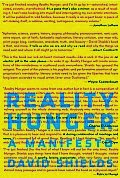
Reality Hunger's Discontent
The death warrant for the novel always seems to be a celebration. Literary forms grow and transform over time; undeniably, the novel may be the most open, enigmatic and constantly challenging of forms. Why would there be a need to pronounce the novel dead if it wasn’t in fact alive and well? One rarely hears novelists proclaiming the end of the memoir, or the end of poetry.
In fact, so often people have a vehement dislike for and anger towards “the novel”--to which I often think: what did the novel ever do to you? Because it is a difficult form that defeats. Maybe what ultimately defeats is a lack of commercial success.
The benchmark of commercial viability is difficult to come by. Only a few books make it to the darling list. One of the results of this is the attempt to invent a new form. Another is to go meta.
Because the form has existed for so long, so effectively, and in light of technology, it seems viable to question the novel’s means and methods are no longer relevant or somehow wanting. Experimental writers take this up as a badge of honor, subverting narrative in the “traditional” sense (The failure to play the commercial game is to buck tradition, to deny what a marketing machine expects and searches for).
To identify a benchmark as baseline is usually the best most writers can wish for; then, to remain undaunted in the long haul of writing a novel, to say nothing of writing one of originality, is a meager dream. This might explain the proliferation of that type of novel that people supposedly want to read, the block buster, which is usually anti-original, formulaic, genre work.
To imagine that anyone is so in love with “reality” or aching for it, we have reality TV programming. But don’t imagine that those reality narratives aren’t shaped into some from of drama in the editing room (to lesser or greater effect--I’m willing to bet that among the writers on those programs is a novelist or two).
Without the anointment of commercial success, and having failed to live up to the demands of the form, so called re-invention is necessary. This is also known as a good career move.
David Shield’s Reality Hunger appropriates samples, sound bites, other writer’s pithy phrases out of context, and re-contextualizes them. He is utilizing the plagiaristic taboo writ large. This is the nature of the web having its influence on publishing. As with blogs, there is so much work to reference and draw from, to lead the reader to more and more information. One has to get read. The present horizon of the mobile text (the ephemeral written word on the web) means the writer can’t count on anyone getting that far into any one particular book. Yet Reality Hunger is a book, not an online text.
Reality Hunger as a text is a great idea. The style is a gimmick that provokes, seizing on the controversial aspects of recent memoir scandal (the appropriating element), as well as wrecking the house on the way out the door (the death of the novel element). But I won’t call it art.
Providing an antidote to an imagined problem is a proven marketing ploy, its effectiveness is a foregone conclusion once the publisher rallies behind it. Whatever the form of Reality Hunger is, it will never replace the novel.
Wednesday, March 17, 2010
Death Of Craft
There seems to be a lot of hand wringing and grief over the end of publishing in its traditional form. If you doubt you had a stake in it to begin with, it becomes easier to embrace the changes. I still don’t quite know what any of this means to me as a writer, but I’m worrying a lot less about what will come of it. And I’m glad to see that the book will never die. Maybe this should be considered the beginnings of a renaissance.
That writers can’t/won’t any longer make money from their work is considered inevitable. Journalism is becoming devalued. An untenable practice. The gist of this scenario is the fear that one’s work will become too easily copied, or reproduced (read: stolen) or worse still, evaporated into digital ether.
Rather than fret with Y2K type doomsaying, I’d rather see concern about craft. Until someone wants to read the work, fears of a plagiaristic public or “the end of cultural civilization” is off the radar.
I can see the day where craft might seem like it is no longer relevant. Is it wrong to say the writing is on the wall? (insert favorite mobile technology here.) There’s just too many voices clamoring to be heard (and voices here is as much the bloggorhea, the instant message which strains to be relevant). I trust I’m not alone in the dogged pursuit of craft. Even as much as the blog has an instantaneous thrill, I still insist thoughts committed to paper gestate before they appear here.
For all the immediacy of technology, the presumed benefit it offers an unheard of writer, I still avoid most of the technology whose expediency is largely useless to me. Had I had this technology available to me fifteen or twenty years ago, I think I would have been less wary, but I’m more interested in saying something useful or enlightening, rather than just chattering away on any old subject. I imagine that’s the case for a lot of writers who consider writing an art form.
On the optimistic side, the clamor is bolstered by the directives that getting published has become so commonplace as to be considered “easy.” But it’s not that easy. Not if you are trying to place your work where it might actually be read.
The all consuming needs of technology seemingly make it easier for more people to have a voice. The proliferation of voices implies there are more voices that want to be heard, and thus less with anything to say, or at least, less with any distinction. To which my immediate concern is an Orwellian death of craft. But the practice of writing has not been rolled under the bus. The tools of technology should not be imagined to have usurped craft.
I'll continue to be concerned with relevance, and craft. Relevance is in trying to get to truth, and to say what’s important. Being able to say that because it’s important to me, I trust it might also be for someone willing to read me.
Maybe this is the future, right here.
Subscribe to:
Posts (Atom)