Showing posts with label reading. Show all posts

Saturday, August 8, 2015

Are there literary uses for boredom?

I’ve read innumerable novels and stories that have slowly and surely bored me to where I was ready to hurl the book through a window just to get it as far away from me as possible. I’ve read recently a number of novels that have been selected for prize shortlists--which would seem to remove them from running in the boredom contest. Instead, I found myself wondering: what defines when a work is boring? The impetus of this question was the prompt in the New York Times Bookends: “Are There Literary Uses for Boredom?”

After a reasonable amount of soul searching, I’ve decided that boredom as a concept is so complex and subjective that an attempt to define it is impossible. So how do I negotiate a concept that I have spent years of my writing practice trying to avoid? Like any writer, I write first for myself, believing, in this way, that I am also writing for an ideal reader, one whom I suspect like me has an interest in what I’m writing and hopes to not be put asleep by it.

One literary use of boredom would be if the writer wasn’t interested in having readers. I’ve made a cardinal virtue of elevating and echoing any number of practitioners of fiction writing who suggest, in more or less these words--always be interesting. Part of what drives me is the process of writing, which involves re-writing, editing, and often writing again, when what you have written fails to excite. In a longer work, a novel or a story, you hope you don’t become bored; if you do, no doubt so will a reader. And if you are re-reading as much as necessary to get a novel into shape, you’ll know by the second or third draft if it’s irredeemably boring, or you should be able to recognize it. If anything, the activity of re-reading your work until you get it right is potentially a boring part of writing; after multiple reads, the newness wears off. But this also might be where the nuance, the stuff that surprises and makes you want to read--and write--further, comes in. In fact, this may be what has led to the proliferation of shorter and shorter forms for writing fiction: it’s hard to be bored with a piece of writing when you don’t have enough time to get bored.

For a number of so-called popular works, it strikes me that the authors aren’t aware that their work may be boring, or, if they are aware of it, they do not care. Maybe they don’t have to care and legions of readers will read them because of their name and reputation. Of course, it stands that they are in jeopardy of damaging that reputation if they ignore this factor.

Many difficult books are known to be tedious--but these works have managed to enter the canon, and doubtless a consciously boring work might never have a chance of exciting the readers of its time, no matter what one’s opinion of Moby Dick, or Ulysses, may be. And admittedly, there were a few boring parts in Ulysses, which I made myself read just to acknowledge I’d read it all. Joyce was said to have sprinkled enough breadcrumbs through his work to keep scholars busy for years. Was he so assured of his readership--and his longevity for that matter? Was his hubris from the certainty of his success in the past, and his stature? If he’d never been read this would be a moot point.
             
To ask if there are literary uses for boredom might also imply that worthwhile, difficult books are ultimately boring. Maybe the boredom comes in when we as readers are not up to the challenge the writer puts forth. Then again, there is a certain amount of second guessing as to whether a work is boring, or simply difficult. If the writer put the time into making a work of complex art, they might also want to be sure that it is read. Difficult and not boring are not mutually exclusive.

There are also works that aim to be merely entertainment, and a lot of the time these are unreadable because they are frankly, not very stimulating. I suspect these writers dumb their work down so much that it becomes boring, as if it seems necessary to lead the reader along without any work to do. On the other hand, it may not be that difficult to write something that is, essentially, boring.

Because reading is an activity, it takes effort to overcome if the act becomes boring. So no doubt that a “difficult” book would be considered, boring. Perhaps if one is bored with work they are reading, it might be worth asking, is it the reader, or the writer? Often, the difficult part of such a work, the intellectual challenges within, is what makes it enjoyable. Certainly I’d prefer if it were also somehow enjoyable to read in the process. So are there shades of boredom in the activity of reading? Does it come down to the use of language, the words on the page, or merely subject matter, or is it a broad combination of factors? Boredom is subjective.

I think the New York Times Bookends question might have been asked in light of Karl Ove Knausgaard’s successful memoir My Struggle, since so many have written about the Norwegian phenomenon, and how he can effortlessly write a single unrelieved scene for fifty or more pages. The criticism leveled is that this must be boring to the reader; at the very least, the idea of a fifty page scene might sound boring to the general reader. But even in the long digressions and passages I never found Knausgaard to be boring. Because it’s one thing to suggest that a concept is boring to a reader, and it’s another to write a very detailed, and compelling scene that can maintain narrative drive for fifty pages.

The number of times I have tried and failed to finish boring books lately makes me think this is my problem. Maybe I’m just bored easily.

Wednesday, July 16, 2014

The Li(n)e Between Truth and Invention in Fiction

In the recent biography Updike by Adam Begley, we learn that the celebrated writer ransacked his entire life for story material. He did it religiously, assiduously. In fact, he didn’t invent anything, he merely mined his own life. I found this both a surprise and a letdown. To read Updike’s stories however, the remarkable observation and acuity with detail perhaps make up for a deficiency in inventiveness.

What I’ve learned from reading Updike is that a fiction writer needs to have a painter’s eye for detail, and this can (or used to) be enough to carry a short story. Maybe my disappointment with Updike is that he hadn’t done more than this—he made fiction look so easy just using the basic tools of life experience--admittedly not a very exciting life, at that.

Contrast this to Alice Munro, in her last collection, Dear Life, she has an addendum onto the final four stories, that they are to be read as essentially biographical. For whatever reason, I have always assumed her stories are autobiographical. Why would I assume this for one writer, but not another?

Maybe there’s a lot to be said for a writer who can take the day to day of their life experiences for story material. If most people did this, I feel like we’d have incredibly boring stories. But as soon as you call it memoir, it changes the game (Just look at Knausgaard). Perhaps as a fiction writer, you are in one or the other camp.

Awhile back I must have decided I was in one camp—invention—versus that of using material from my life for fiction. Let’s call them inventors or lifers. I believe I’m incapable of writing a fiction from life, period. I just call it memoir. And because I’ve always coveted Updike’s writing, I assumed he had a natural way with invention.

Jim Shepard’s short story approach, as far as I can tell, is to research a subject that fascinates him, and imagine a story from that. It’s possible some of Shepard’s personal life creeps in to these stories, but really, how much? For example, the details of his recent 2013 Best American Short Stories story accumulate and deliver you somewhere that an Updike-ian story would and could not. So much in Shepard’s work is joyfully inventive, and I think it is in this kind of discovery that a writer makes, rather than the prosaic details of a less than fascinating life, that are what provide the transcendence that can elevate fiction. What’s convincing is the voice, and the fantastical elements within realism, or maybe it’s a transcendence of realism.

Stories that are invented need to be convincing, or some element of the writing has to lift it above mere narrative. Is what Updike pulled off the opposite of this–that his attention to detail makes the story convincing?

I find it interesting that almost all writing of anything of psychological depth is interrogated in terms of “did this really happen?” This might be a credit to the skills of the writer; isn’t there something to being able to transmute life into a story?

What is behind these arguments and discussions about whether a fictional story “really happened” or not, is that it might make the work more compelling. Because there is less at stake, the detail carries the story. Also, a key to a story written from life is its engagement with a gossip quality. Once we know it is based on life, there’s a curious desire to figure out who the characters are based on.

With invention, the writer is relying more on alchemy of a sort. Writing from life, the story is the material. Writing an invented scenario, the material is the story (is this a canard?). Maybe the language enters into the efficacy of the telling, but at some level, the narrative can’t involve distracting language. Is it possible to write a memoir to the level that transcends the language? This speculation could be entering the curious avenue of beliefs. Does Updike’s fiction now seem more compelling to know that all this stuff in his hundreds of stories actually happened in his life?

For me, there’s more of a charge out of writing from what I don’t know. I explored this extensively in an earlier post, “Against Personal Experience”. Something I did not say in that piece was that living life might tend to make you more aware of possibilities in your writing.

Updike would just recycle his experience through characters’ lives. I think, in fact, Updike would essentially rewrite the experience as a story, but he would not place the characters in Afghanistan, or have them drive trucks in Nebraska, for example.

This is not the same thing as invention, on the face of it. I will use the psychological elements of an interaction, but not the setting or scenario. So is it simply that writers are merely using these psychological elements in more or less invented situations? Is this distinction too unclear?

What these questions might actually be getting at is the authority of the writer, how writing seems to establish a benchmark on a detail or an incident from an actual life (or rather involving many lives). If the ancillary characters (based on real people) don’t see themselves as particularly involved or invested in that incident, as they may or may not be, they will feel slighted no matter what is said. The subjective encapsulation will never be enough, or it will be too much. In Updike’s fiction, generally, this seems to be the result; he often waited years to publish some of his more scandalous stories. He still wrote it, but what he wasn’t able to reveal he avoided publishing. If readers who are undeniable subjects of a story question it, it’s like questioning the version that is being told, since it is plainly, unavoidably, subjective.

Tuesday, May 20, 2014

A Reading on the Penultimate Eve of the Possible

HAARP, a literary journal brought to an unwitting public and published by The Hexagon Press, and as part of The Possible exhibition in cooperation with The Berkeley Film Museum & Pacific Film Archive, are publishing one of my poems, “Of Kafka” in their third and final issue, Vol. 1, No. 3 (scroll down to third issue to see index). In addition, there is a reading at Adobe Books (San Francisco) on Thursday, info available here.

Update: The link will allow you to download the PDF of the entire issue!

Tuesday, November 27, 2012

Unprecedented Literary Renaissance


 When I started writing seriously, I could easily get caught up in one or two writers, for example, James Joyce and John Updike. Joyce, because I’d set myself the task of reading Ulysses, and Updike, pouring through a backlog of New Yorker’s at the cafe where I pulled espressos and dreamed a much older person’s dreams (I was in my mid-twenties). In between I wrote fiction. You could wonder if someone so limited in their reading could say of themselves that they were writing “seriously.” There were a few writers before that I’d read extensively (Thomas Mann, Henry Miller, and Samuel Beckett), but perhaps not gone beyond admiring, and certainly not knowing how they might influence my own writing. Needless to say, it took me several more years of unbridled reading until I began to get some sense of what I wanted my own writing to be. By unbridled reading, that meant latching on to a few writers at a time--not unlike the way I read now--until I assimilated some of their influence (if I chose) and moved on. At that rate, it wasn’t a surprise that I could get no one interested in my work. I’d had no general idea of the current world of fiction, and felt more comfortable with my nose buried in work that was decades old.

Now I’d like to believe I read widely, enough to have a sense of what’s happening in contemporary literature, while still dipping into the past to remind myself of what first got me interested in writing.

Just on the basis of the Best American Short Stories 2012, the short story has changed quite a bit in the past few years and has become incredibly, almost ridiculously, vibrant. This collection is one of the strongest groups of stories I’ve read in awhile. I haven’t looked at the BASS in several years, but to compare it to equivalent collections that I have read, almost every story here surprises in ways that don’t feel formulaic, and don’t derive all from a single kind of narrative style. The variety is inspiring. Where in the past I might have recommended only two or three out of twenty of the stories, in the Best American Short Stories 2012 I’d only steer a reader clear of two or three out of twenty.

I don’t know the numbers or statistics, but I believe we’ve seen a renaissance in fiction writing in the last ten years. My own interest had been reignited almost simultaneously with following what was taking place in the world of fiction, writing and publishing, and so much of this came about because of the pervasiveness of the web. I might even argue that it’s nearly impossible to write in a vacuum anymore (i.e., just reading the ancients); or there’s no good reason to do so if you are trying to get your work published. I’m sure there are writers who choose this, and some might slip out of the slush piles and get something published; but besides being pointless (without at least some broad knowledge of what’s happening in contemporary fiction writing), why wouldn’t one be interested in reading what’s out there?

In this renaissance, there has been backlash and critique of MFA programs with the rise of MFA programs, and this has probably forced the tide of short fiction and fiction in general. It already feels like a tired complaint to bemoan their proliferation. No matter what, writing short fiction today might be best categorized as a free for all. Any and everything seems to go. In terms of form, style, subject matter, you name it, the only rule seems to be, there are no rules. There’s  a lot more variety.

Because of the sheer variety, the number of publishing venues, the diversity of voices and viewpoints, we’re no longer in the quaint realm where an alcoholic working class writer in Chico, whose greatest contribution was a naval gazing minimalism, could be claimed as the leading influence of a generation. But even that ‘generation’ label limits the group of writers producing exciting and interesting work today.

Now we have the effects of David Foster Wallace’s modalities, which were even in his hands limited to a post cold war American culture formed primarily via the television. Strange how Wallace, to my knowledge, never ventured with depth into the internet and yet, because his approach feels intrinsically connected to it--his rise has come about with the rise of the web--his imprint has been even more pervasive on the writers that have come after him. More pervasive an imprint than Carver might have ever made in his time. Wallace, in an earlier time, might have had marginal impact on the larger scene, or only in academia. The web’s saturating influence is lending to the multiplicity and variety of radical stylistic shifts that are taking place. TV has become little more than a joke with minor influence, in the new landscape.

There are few journals that have what approaches a similarity of style, or as was once claimed, a derided “MFA workshop style.” Though the general guidelines are about “writing of the highest quality,” that doesn’t mean much. You almost have to get the gist of a journal’s stylistic proclivities. And if you are entering contests to win, in fact it’s best if you have an MFA or better still, a Ph.D., and a professorship at one of the millions of MFA programs doesn’t hurt, either. Yet I suspect, if my own publishing experience is any guide, you should write whatever you want (adhering to high standards of quality, of course) and someone will find you--rather, you will luck across them. Don’t count on the contest circuit. If you wonder where your work fits, it will (or should) find its place.

Long live fiction, and the train wreck of MFA programs. It’s a great time to be a writer.

Tuesday, August 30, 2011

Moment Of Clarity

You can spend years learning how to write stories that someone will want to publish; you can analyze every story you read to the point where you draw the life out of it. One day you discover you are doing it--writing stories that someone wants to publish--and have done it.

In the process, you realize not only have you done it, you’ve done it your own way.

I don’t know if you can go so far and say you have a voice or something like that--maybe with enough work amassed you can see that, but one of the hardest things to do is to be objective about the work you’ve spent so many hours, days, and weeks on. So it’s always a surprise when someone does want it, though because you have done all the homework you shouldn’t be surprised.

The compulsion is still (for me) to go back again and look at what other writers are doing to see anew how it is done. I am always reading a lot of work, much that I am not always excited by, just to see if there is something I can learn from it (maybe, what not to do.) When you enter a dozen contests a year, the journals start arriving in the mail whether you want them or not. I usually don’t, but I paid my entry fee, and there they are. I read them anyway.

I’ve had this feeling on numerous occasions when I’m writing a story: that this one will get published. I don’t mean to sound arrogant or over-confident, but there is often a moment of clarity that seems to be the reward for the willingness to show up and do the work. That moment, out of nowhere, is sublime. And that moment isn’t exactly that certainty that it will be published, it is more a sense that “I know this story has the quality and the spark to be well-published.” Since it has happened a few times, I have to believe there is something to the notion.

In the best cases it’s when I’m writing the story, and I sense someone might connect with it; again, probably because you can recognize that quality when you read another writer (maybe 10 percent of the time) you begin to recognize that quality in your own work. Some might call this a voice and I suppose that’s what it is. I really believe this absorption in a wide variety of fiction makes finding one’s voice inevitable. You can learn and assimilate much by reading a lot and widely. It has less to do with reading “how to” books and more with reading good fiction.

On the other hand, I’ve spent months on stories that I’m quite sure will never see the light of day, but there is some reason I persevere with their doomed venture. I’ve come to learn to take my time. A story I started in May is only now shaping up, and I feel confident that it will resonate with someone. But that confidence is the best gift one gets for having written year after year when there was seemingly no one that was going to read your writing. That’s what the ten years on novel number two, forever relegated to a banker’s box of drafts in the closet, was for.

Friday, April 16, 2010

A Beautiful Necessity

"What I know about writing I know from having read the work of the great writers." So says Richard Bausch in The Atlantic, regarding his one foray into contributing to an ill-fated how to collection of essays in which his work was unceremoniously left out.

I think the impulse to offer how to advice is as much out of reminding oneself how it is done, as a form of practice; if someone finds it useful, so much the better. What I like in Bausch's attitude is that he makes explicit what I assume, in my good nature or goodwill, is everyone's motivation. Of course this is naive. I suspect there are millions of people for whom writing is not derived from "a kind of beautiful necessity."

Thursday, April 8, 2010

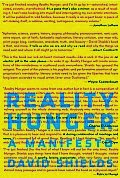
Reality Hunger's Discontent

The death warrant for the novel always seems to be a celebration. Literary forms grow and transform over time; undeniably, the novel may be the most open, enigmatic and constantly challenging of forms. Why would there be a need to pronounce the novel dead if it wasn’t in fact alive and well? One rarely hears novelists proclaiming the end of the memoir, or the end of poetry.
In fact, so often people have a vehement dislike for and anger towards “the novel”--to which I often think: what did the novel ever do to you? Because it is a difficult form that defeats. Maybe what ultimately defeats is a lack of commercial success.

The benchmark of commercial viability is difficult to come by. Only a few books make it to the darling list. One of the results of this is the attempt to invent a new form. Another is to go meta.

Because the form has existed for so long, so effectively, and in light of technology, it seems viable to question the novel’s means and methods are no longer relevant or somehow wanting. Experimental writers take this up as a badge of honor, subverting narrative in the “traditional” sense (The failure to play the commercial game is to buck tradition, to deny what a marketing machine expects and searches for).

To identify a benchmark as baseline is usually the best most writers can wish for; then, to remain undaunted in the long haul of writing a novel, to say nothing of writing one of originality, is a meager dream. This might explain the proliferation of that type of novel that people supposedly want to read, the block buster, which is usually anti-original, formulaic, genre work.

To imagine that anyone is so in love with “reality” or aching for it, we have reality TV programming. But don’t imagine that those reality narratives aren’t shaped into some from of drama in the editing room (to lesser or greater effect--I’m willing to bet that among the writers on those programs is a novelist or two).

Without the anointment of commercial success, and having failed to live up to the demands of the form, so called re-invention is necessary. This is also known as a good career move.

David Shield’s Reality Hunger appropriates samples, sound bites, other writer’s pithy phrases out of context, and re-contextualizes them. He is utilizing the plagiaristic taboo writ large. This is the nature of the web having its influence on publishing. As with blogs, there is so much work to reference and draw from, to lead the reader to more and more information. One has to get read. The present horizon of the mobile text (the ephemeral written word on the web) means the writer can’t count on anyone getting that far into any one particular book. Yet Reality Hunger is a book, not an online text.

Reality Hunger as a text is a great idea. The style is a gimmick that provokes, seizing on the controversial aspects of recent memoir scandal (the appropriating element), as well as wrecking the house on the way out the door (the death of the novel element). But I won’t call it art.

Providing an antidote to an imagined problem is a proven marketing ploy, its effectiveness is a foregone conclusion once the publisher rallies behind it. Whatever the form of Reality Hunger is, it will never replace the novel.

Thursday, February 18, 2010

Books Once Loved

The idea that I can’t love a book forever feels despairing to me. Or formative.

There are a handful of books I claim to love. So it’s odd to go back to them. Does the love fade, or did my taste change, or is a book love good only for one brief moment in time? Mating, by Norman Rush, is feeling like that. When I first read the novel in 2001 or so, I remember feeling a lot more giddy with the book--the classic recognition that the book was written for me. That idea is fast approaching a clichĆ©--but this is how I feel when I find a book I can’t wait to keep reading--only hoping it won’t end. Re-reading Mating now, though I can see what is compelling in the writing, I also find the first person narrator too self-conscious at times, the writing clever in the manner that I’ve been criticized for, and am now, post-MFA, overly conscious about.

As much as I enjoyed and was sucked into Dan Chaon’s Await Your Reply, at the end of the book, I wasn’t as in love. The prose is crafted but doesn't attain an untouchable category for me. The novel is certainly well plotted, and masterfully executed, but the prose is largely getting from point A to point B. There isn’t much that I take away from the characters or the prose that will stick with me.

And maybe that’s the point: the love has to take hold from the start. At the end of Chaon’s book, I thought, it is good, perhaps even brilliant. I could learn from this book. But do I want to re-read it again? Doubtful.

The beloved category books work a magic that is maybe from a combination of where I was in my life when I read it, and as much from what I brought to the work.

For awhile now I’ve been disabusing myself of the notion that I can go back to the books I once loved and feel the same frisson all over as if I hadn’t read dozens if not hundreds of book since, enough to have altered my tastes and views (as well as what time will effect) so that I could never go back and find the same experience again of a book.

But as I’ve been finding fewer new books I’m eager to read, I’ve become so desperate that I’ve even gone back to ones I read a year or two ago and really liked, if not quite loved, and re-reading them. The trouble with this practice is that I still know the story too well, and so I have to look for something else to draw me into the narrative. Often then, I get caught up in the surface (having glided across it, perhaps, initially). Because if the surface isn’t smooth, or is reflecting something I didn’t notice before, suddenly that’s all I see. I might forget the depth I easily found in the first read through.

This is not a definitive list, but among the handful of books I’ve gone back to and found richer and more rewarding the second or third read--and that I loved from the start--would be The Lover by Marguerite Duras, and The Sea by John Banville. (I eagerly await Banville’s The Infinites, which is being touted as a return to form, which I welcome.) I’d add to this Saul Bellow’s Adventures of Augie March, Philip Roth’s Sabbath’s Theatre, and Julio Cortazar’s Hopscotch. Most of Beckett’s novels I can re-read forever, too.

Still, maybe the idea that that book love is unchanging is one best jettisoned. Why would I ever need to keep trying to find the next one, otherwise? I may say, “This is a perfect book,” or, “I loved it,” but maybe that’s just infatuation.

Friday, January 1, 2010

Two Thousand Ten

The saying, “Do what you love and the success will follow,” is always one I’ve heeded, religiously. Primarily because my priority is to do work that I enjoy since I’m going to spend so much time doing it. Writing has certainly led this call for me, though after years of practice, the hankering for further extrinsic reward is undeniable. I’m not sure if that’s necessarily financial as some think it is. It is about public acknowledgement, perhaps, though the numbers of beloved artists who are satisfied with their work are probably equal to those that are dissatisfied.

I often wonder about motivation for my fellow writers--I don’t get people who want to write because they want to make a best seller list (which seems equal to thinking you could win the pick six). I don’t get people who want to write though they don’t like to read. It’s as if everyone wants to be a writer, as if it’s been glamorized beyond recognition. For the longest time, everyone wanted to be an architect, or at least this is how it was reflected in Hollywood screenplays.

I know that, in 2010, I’m still deepening my practice, I’m still learning and loving the work, the craft on the page, the music and conceptual frisson that can be found, and deployed, in a long work of fiction. It’s the life of the mind, still, just as it was for me seventeen years ago. I don’t expect a huge success, but the incremental one has been encouraging and rewarding. I’m reminded of when, four years ago, my college advisor tried to level me a bit with what he presumed to be my false ambition; no matter what, I still appreciated that honest advice, though his cautionary reaction was more fitting advice to someone who hadn’t struggled at something that he was going to do no matter what reward he got out of it.

No matter what one talks about in the pursuit of a writing career, there is no field I know that has so many naysayers who don’t want you to have this thing you are passionate about on your terms. Unfortunately, these are often the gatekeepers; fortunately, they’re not all naysayers. All of these naysayers can’t take the love of the writing away, and I’m confident I’ll outlast so many of them that I won’t eventually care anymore.

Happy 2010!

Tuesday, December 22, 2009

Esteemed Nicaraguan Novelist

My review of Sergio Ramirez’s A Thousand Deaths Plus One is in the new print edition of Rain Taxi:

"[...]The two short stories that open each half of the book link the cultural figures (in the novel) and provide a skein of themes that the novel elaborates upon . . . Ramirez channels a style similar to what W.G.Sebald conjures in his works of remembrance and soi-disant history."

Here is the link to the actual review.


Monday, June 22, 2009

Wisconsin Review Publication


At long last the Spring 2009 issue of Wisconsin Review is out, where my story “The Edmonton Farrell” can be found. Here’s the link to their page where this wonderful journal can be ordered.

Tuesday, May 26, 2009

Some Great Advice

Annoyingly pretentious, or maybe just ornery? I enjoyed the Annie Proulx interview in the latest Paris Review  (unfortunately, to read the entire interview, you need a subscription) and decided to crib from it whole quotes because she says some great things about writing short stories. I've added my thoughts in parenthesis.

On sentences: "A lot of the work I do is taking the bare sentence that says what you sort of want to say--which is where a lot of writers stop--and making it into an arching kind of thing that has both strength and beauty. And that is where the sweat comes in. That can take a long time and many revisions. A single sentence, particularly a long, involved one, can carry a story forward. I put a lot of time into them. Carefully constructed sentences cast a tint of indefinable substance over a story."

On reading: "You should write because you love the shape of stories and sentences and the creation of different worlds on a page. Writing comes from reading, and reading is the finest teacher of how to write."

(I've been preaching about reading for years.)

On how you know when a story is finished: "It is impossible to answer. You just know. I suppose it's the thing Hemingway referred to as the built-in shit detector. I think one develops a built-in shit detector through a wide reading of other people's work. And if you  can't see the ghastly bits in you own writing you shouldn't be a writer. It's a pity that his shit detector failed him in later years."

(I agree on all counts--anyone remember "The Garden of Eden" (which I enjoyed anyway)?)

On revisions: "I once heard Ha Jin say that it was not uncommon for him to do more than thirty drafts. I do not usually do so many..."

(I think thirty could be overdoing it, but when Ha Jin and I share space in the same table of contents, I promise I'll eat my words.)

Sunday, May 24, 2009

Must I Write?

There is something almost self-defeating and pointless to the idea of producing art for a market place. One must either already be established or they have to get established, taking some slow road to publication through journals or the proliferation of web outlets. Blind optimism and dogged determination are the factors that must reign because if you don't want complete obscurity, you need to try to fit yourself in.
I can be accused of hyping (maybe too often) the books that the major news media hypes, while generally overlooking the obscure, humbler publications that are put out by little known publishers. But on occasion, browsing a bookstore or a review site, I come across a work by accident and the writing to me is as original, interesting and compelling as the hyped one I set out looking for. I take heart in that. If the New York Times Book Review christens a book by making it the front page review, and everyone falls in line, that doesn't necessarily guarantee book sales or even that the book in question merits the attention--I always wonder about the back room machinations of those choices. Was it one top editor's favorite read that week or did the publisher promote it with enough advertising money to make it appealing? So many of these books then never catch on, so what does that author do?  
Authors are inclined to have to do their own hype and marketing strategizing, whether they are in a featured NYT book review, or published by the Unknown press (I suppose self-publishing comes into this, too, although the lack of an extrinsic vetting process leaves me dubious about self-published writing). I can surmise that in the realm of promotion, at that point the writer probably simply wants people to pick up their book and read it. If there are only a handful of fiction writers making a living at their writing, what is the point of trying to do it? Well, I go back to my original motivation, and I feel like if it's art that you are creating, that can sustain you in and of itself. Maybe not. Still, I've decided to play the game but I keep my eye on why I'm doing it--it's that call that Rilke suggested in "Letters to a Young Poet":
"Go into yourself. Search for the reason that bids you write; find out whether it is spreading out its roots in the deepest places of your heart, acknowledge to yourself whether you would have to die if it were denied you to write. This above all--ask yourself in the stillest hour of your night: must I write?"
Writing in the web sphere, it's second nature for me to develop a constant stream of ideas about how to promote my work. For me, this is a combination of curiosity and fascination with this technological medium at my fingertips, but I recognize this can also be a huge resource drain. Yet I always remember when I didn't have this outlet, not so long ago. As distracting as it is, I keep it in check and have to pull back on occasion to remember my artistic calling and goals. I suppose if I had the publishing world clamoring to my work, I wouldn't get so caught up in the notion that I'm writing this and someone out there can read it if they like. Sometimes that's enough.

Monday, May 4, 2009

Short Story Openings

I never intended to become a short story writer. In grad school, I didn't even bother with short stories, knowing they were the slow road to publication in the shadows of the more prestigious novel publication. Every serious writer usually wants to be known as a novelist, ultimately. There's just a stigma to short story writing. Of the successful short story writers I can think of, I'm sure there is still some ambivalence for them in that they have staked their reputations, however unwittingly, on short fiction.
Nevertheless, here I am. I did set out to publish as much short fiction as I could two years ago when I saw that the traditional approach to attempting to get a novel published (get an agent, get a book deal, etc.) was taking forever. So I decided to work on a level that I could see the results, and I'll admit, I am further along in two years than I could have dreamed. Awards, publication, a life changing trip to Thailand, and meeting some amazing writers along the way have been some of the payoffs. I think I can say I now know a little something about writing short fiction.
When I began, I had no idea what to do with a short story. I did what I always do, I make the attempt, and I try and try until something happens. This involved reading a lot and experimenting. If nothing was going to happen within a few months with those first stories, I thought for sure I'd know I had failed. My first serious attempt was "What You Catch a Glimpse of, Forget as Soon" (available to read in pdf here, page 44) which was, in my mind, not so much a story as an exorcism of energies around so many things I was struggling with at the time. That story just carried me in the writing of it, and I thought it might resonate with others. It did. Along with that story I tried to revive some earlier stories (mostly unsuccessfully) and took a chapter from my thesis novel and transformed it into a story which then received a place and was picked up (for a time, by two magazines--see here) and got me invited to Thailand. As for "What You Catch a Glimpse of", it received enough favorable response that I saw that it had something in it that worked. When it works, you try it again, maybe altering it a bit as you go. But this is about how to begin.
Story openings
The first problem is always the beginning (not necessarily the first problem you have writing a story, but the one you have when you want to get it published). This is a successful example in journalism, of a beginning, also known as a lead:
Back in the heady days of the dot-com boom, casual Fridays seemed to lead to casual weekdays and, in short order, a re-definition of the entire concept of "dressing for success." Call it the anything-goes dress code, where flip-flops and Lynyrd Skynyrd T-shirts were often the sartorial norm for highly educated, well-paid professionals in the Bay Area.
("Dressing for Success: Follow the Dress Code to the Top." The San Francisco Chronicle, Jobs Section, 8 April 2007.)
That's a zinger of a lead, that first sentence, and it's what propels a reader into the piece. The same approach can be applied to short fiction. That opening has to start a fire of some kind. Here are some examples of first sentences (in bold) with their follow up sentence or sentences, more or less at random:
Underwater, there are many ways to die. This was the first thing I learned. Today we are doing our safety checks. The scuba instructor points to the board, he goes down the list, nitrogen narcosis, he says, carbon monoxide poisoning, hypothermia, air embolisms, the bends, blackouts. My son suffocated in the womb. The cord was stretched too tight and he died. I have a pain in my ears every time I dive. I can't go past ten feet without feeling the pressure in my head. The doctors say that in the womb babies learn to breathe liquid before they learn to breathe air. I think it's beautiful to think of my son this way.
(Urban Waite,"Open Water", Agni)
I could say, for example, "There is no amount of money that will bring the six-year-old girl back to life, but even so, our company will provide a reparation to the family." I could say these words in English, Hindi, and Arabic—but not Urdu.
(Matthew Quick, "Do Not Hate Them Very Much", Agni)
To go back to my own stories, this is what I devised for openings:
There are gestures, unmarred by the words put to them after all has failed. When Y. stopped you from talking to apply lip balm to your dry lips. Or she sidled up to you to read what you had written for her. When you lay on the grass together she put her head on your chest and curled her body around you. In the night you watched her sleeping, you heard her teeth tapping as if taking little bites of number twelve spaghetti, so quietly. Her hand gripped your shoulder. Gestures cannot be undone, incomparable.
("What You Catch a Glimpse of, Forget As Soon." 21 Stars Review, March, 2008.)
The last words I called to Maren, My darling, please take hold of me!
In the water she did not hear me.
("It Was a Tree That Saved Me"Evergreen Review, Issue #115, January, 2008.)

These openings throw you into the world of the story, and clue you into what the story is about. I would even go so far as to say they encapsulate their stories. How?
Underwater, there are many ways to die. : A man who attempts to master his fear of dying after his own son dies. To take it a bit further, the parallel to the unborn child's experience is metaphorically related to that opening sentence.
I could say, for example, "There is no amount of money that will bring the six-year-old girl back to life, but even so, our company will provide a reparation to the family." : A truck driver rationalizing an accident in the urban strife of the Iraq war complicated by ethnic divisions.
There are gestures, unmarred by the words put to them after all has failed. : A man coming to terms with a relationship in light of reflection and self-knowledge.
The last words I called to Maren, My darling, please take hold of me! : A man loses his partner in a tsunami and wanders the beach looking for her.
This is a good approach if you have a powerful story to tell and you want it to be read--isn't that what all short stories should aspire to? I'm not saying short story openings can always be interpreted this way, and I doubt every writer would agree with this approach, but if I can find examples of it in a handful of successful stories, then I believe it must have some truth.

Interested in reading more? Check out a recent post, on Philip Roth's First Person Point of View in Operation Shylock 

Tuesday, April 28, 2009

Crafting a Chair

When I'm working on short fiction, invariably I have half a dozen books lying open--a kind of loose reference to see how an accomplished writer evokes their magic in a turn of phrase or when utilizing tone--if only to remind myself what I'm attempting to do with my 6500 word story that is on the fourteenth draft, the fifth title change, and contains more mixed metaphors and false sentiment than a Harlequin romance.
The books I'm looking at (at the moment) are Paul Theroux's The Collected Stories, Ian McEwan's The Comfort of Strangers, Jhumpa Lahiri's Unaccustomed Earth and Norman Rush's Whites. You can't go wrong with such a stellar selection (one of these is a novel, and McEwan is about as masterful with tone as Yehudi Menuhin). Or maybe you can.
The best writing looks effortless because maybe it is--for a master. For the rest of us, I think reworking a story beyond reason becomes apparent in the reading. I can't tell how many times I've had a story idea that I worked and reworked to the point where I should have simply put the thing out of its misery. Too many to count. I'm sure this is the case for a lot of writers starting out, and once you find your "method" or at least a method that works, you shouldn't linger any longer in the workshop than you have to.
Chris Abani once told me writing fiction should be like crafting a chair. I interpreted his words to mean you go into the workshop with a clear objective in mind. Maybe you pick up where you left off the day before, and you can see this chair is going to take a few weeks. But you are working to get it finished. Hopefully it will be beautiful when you are done. It's not about mass production, in other words. Too often I compare my story to another writer's story as that is what it suggests to me--in other words, it's a kind of copy cat style--trying to replicate what another writer has done successfully. Which is both the danger and solace of returning to those reference works. You can try too hard with a story to make it fit into a mold that it will not fit into--and the organic growth of the story isn't there. 
There isn't anything wrong with imitating a successful story, as long as what you end up with is distinctive enough to stand on its own. Once it takes on that life it will never (or rarely) be compared to what has gone before. But the best stories I've written, the ones that have gotten me notice and acknowledgment from editors and readers are definitely not the ones that I am still working on after nearly two years and more than twenty or thirty drafts. (And is there a limit? Maybe seven or eight solid drafts. If you can't get the story down in the first two or three, maybe the idea is half-baked and you should let it sit until you can finish a first draft.) On the other hand, the best ones are written in a kind of fever of inspiration, where I took the trouble to commit it to paper. In a sense, I felt as if I had to write it. I'm grateful for that. I think you can force inspiration, but it's sweeter when you can trust it to come to you, eventually.

Saturday, April 25, 2009

Philosophy Made Me

As I read this article, "Against Readings," in The Chronicle Review, it reminded me of my own literary beginnings, which really began with philosophy. 
 
While studying fiction in grad school for creative writing, there was an expectation to treat the books we were reading as academic exercises. But I felt there was something alienating with literary interpretation; as much as I would have liked to have considered I had the potential to undertake that work, I had always preferred my own approach: unhindered reading, culling from a well of intuition, and drawing my own conclusions. I discovered that my advisors--steeped in and perhaps blinded by their academic backgrounds--often had a hard time with my open approach. 

Unless one is incapable of thinking deeply, carefully and thoughtfully about what they read, I have never understood why any approach other than a self-interpretive one makes sense. I think this rings true for someone like me who indoctrinated himself in philosophy out of curiosity and circumstance. Stuck every Saturday at the mall for two hours, after boredom with video games (or I ran out of money), I wandered the aisles of B. Dalton's and found The Myth of Sisyphus, Walden, the Tao te ching, Being and Nothingness, and Bertrand Russell's The Conquest of Happiness (believe it or not at a ripe fifteen). Eventually, there were generous readings of Emerson and William James. After the enlightenment of half a dozen courses that touched on these subjects in my undergraduate years, I ended up with some clever misinterpretations of Derrida via a whacked out architecture curriculum with undigested bits of Foucault thrown in for good measure until, searching for solace amid this despair, I finally discovered literature capital L (Henry Miller, Thomas Mann, Borges), landing in a no man's land of my own making. But I wouldn't have gotten there without philosophy. 

Early on there was no one to talk to about what I was reading--that would have to wait for college and some surprisingly astute teachers--I didn't know anyone who had read these works, and I wasn't finding copies of them in high school. I was secretly proud, and quietly uncertain, but somehow affirmed to have discovered my own rejected thoughts in their alienated majesty in books written long before I was born.