Showing posts with label end of the written word. Show all posts

Sunday, January 8, 2017

On the Future (Further) Intersection of Technology and Literature

One form of literature, at least the one that thrives through publishing on the internet, has been transformed by the internet. I’m talking about short fiction, the kind that is most amenable to the attention spans of individuals who use electronic devices. This is one way that we could posit that technology has made an impact on literature. This literature, in fact, is most often where the cutting edge appears because it’s not produced and hashed out by a marketing team.

What does the future of cutting edge literature look like? It’s not in traditional books, or rather, it’s no longer necessary for books to exist in order to present it.

I’m of a generation of writers who are almost a “creation” of the web. Of course, the web did not create me, but if it did go away, so would go away--at least in the digital ether--much of what I consider to be my best and most important work. Essentially, my work came of age with the web. Or I came of age when the internet did. I don’t know if I could conceive of the writing path that I’ve taken in the last fifteen years or so in any other way.

If you consider technology to be indispensable, maybe you ask that question, what if the internet goes away? On the one hand, there are those who believe it’s foolish to have any investment in the web (they shun having their work published there; they either can afford to, because they are safely ensconced in legacy publishing, or they don’t care about the web, consider it a fad or whatever, and maybe they do or do not use it as a tool, etc.), and on another extreme are those I would call the immersives who believe anything is possible, for example, that the web could evolve to the point of spontaneously producing intelligence. (If you think I’m grasping here, just watch this clip from Werner Herzog’s Lo and Behold: Reveries of the Connected World) The web, and its inherent potential, is essentially out of our hands. It is uncontrollable.

If the internet vanished, there are still the people who have created the work, they will create more, and there will be new creators to come. Are we “dependent” on it like life support, or is it rather that we don’t--and can’t--imagine it going away? And even if the internet did vanish, something new would be created to replace it, probably Web 2.0.

To look at the changes that technology has wrought to publishing over just a few years: new ways of marketing, and more venues for one to promote themselves--these tactics can seem merely superficial. On the other hand, the broad reach and availability of these tools has made the web pervasive. What is significant is the impact of the web and its potential to reflect a zeitgeist. An arguable point is that the web has only become more essential, more necessary. For those firmly entrenched in legacy publishing, the internet is a supplement, if it’s not a foregone conclusion by virtue of what it lacks in relation to traditional print publishing. Equally, print might seem irrelevant to a lot of techies.


Again, no matter what changes and developments come, as far as the web and publishing, technology will always bring something new. Because we are constantly working within the technology, it is bound to change; technology constantly evolves. It is almost a “live” organism, in this sense. Whereas there have been no major innovations in the basic technology of the printed book for thousands of years.

In some sense, even writing is static. But perhaps the capacity of the creative minds that produce literature is a realm that is unpredictable, with a potential that we might never fully understand enough to have the capacity to reach. And this touches on notions of artificial intelligence creating a kind of literature. Such expectations I think are still beyond viable; it ultimately takes a human mind to craft the narratives and imbue the poetry of language with the lyricism that humans can grasp.

Since the dawn of the internet, every social media company with a significant financial stake in it has been trying to figure out how to monetize the web; the only way--or the main way--is subscriptions and advertising. If you put any intellectual content out there, you try to monetize it. Those producing it may not have a significant or pressing financial relationship to it. People may not feel obligated to pay for something they can ultimately get for free. This puts someone like me at a disadvantage. My options would seem to be to get into more paying venues. But the truth is that I’m not going to stop writing because no one is paying me.

No matter what speed technology can provide for the processing of data, reading and writing occur at a relatively slow pace, which is more or less fixed. It’s the same as it was 100 years ago, or as it was 500 years ago, and further. Could this convince us that book technology won’t change  for a long time, if ever?

The book, in some form, has been around for thousands of years. The computer, the tablet, et al, for less than a few decades. None of these advances have changed the book. Writing is a quiet and ancient technology in contrast to all pervasive technology as we know it. The change for writers, if they choose to utilize it, occurs mainly in the means of putting the work out there. The book is a relatively stable artifact. If we consider the futurist thinking of far flung possibility, maybe at some point a chip or device planted in the brain will allow access to all books. Then you’ll never need to read a book, you will have vague memories and knowledge of having already read it. Or you will be able to access it from the cloud you plug in to your brain. But even this won’t really change the way the literature that it contains is created. Someone still has to write the literature.

(Photo by Kyle Bean "The Future of Books" website, here.)


Friday, February 1, 2013

Submit or Bust


Print is still--and maybe always will be--the coveted realm of publication, so it seems odd that print journals are more and more striving to banish hard copy (aka snail mail) submissions. From a recent attempt to put together some mail submissions, my cursory survey indicates that the tide seems to be going this way.

I’m noticing a lot more online only submissions from journals that used to take mail submissions, and I’m of mixed opinion about this. Since print publication is the coin of the realm, it seems counterintuitive to have the work processed electronically by quality print journals (Willow Springs, Sycamore Review, Gulf Coast, among many others). Many charge $3 for this service, through the dominant submission site, submittable (which had the unfortunate name submishmash for awhile, which is how I thought they probably felt about the deluge they were asking for with this system). After signing up and using the service for a few journals, I didn’t realize until recently that one password would allow access into a system that offers no indication of which journals it serves, knowledge which could have spared me confusion and inevitable password headaches. When using submittable, you see a list of your submissions in a spreadsheet, the name of the journals you have submitted to with the annotation of either “Received” or “Declined.” Some must also see “Accepted,” of course. Many of the smaller or less profile journals use the system, though without a $3 charge.

The $3 may seem no more than a nominal charge considering how much an actual mail submission costs: postage, anywhere from a dollar to two or more, envelope, return envelope with postage, and printing paper, as well as the time involved. In a sense, these journals are getting the money you would otherwise spend to send a hard copy.

For all the time investment and inefficiency of snail mail, I prefer it because, like the lowly and costly journal in paperback form it aspires to, it puts something substantial and tactile in hand. It won’t evaporate with one key stroke. It is, more and more, put into a recycling bin when it fails to impress--but its chances of being a felt presence on an editor’s desk seem more comforting to me, maybe because it materializes something that came out of my mind.

As for the electronic format, if the work is only published online and not in print, it can have a brief, lowly half-life when someone hacks the journal’s website and destroys hundreds of writers’--and editors’--work. This happened with a journal I had work in, which I’ve never been able to confidently call published because the website is gone. There is often this notion that work committed to the world wide web is public forever, but somehow, it’s never the work that you might want to be available.

I am warming up to the electronic transition. But not much. I don’t particularly like reading on a screen, though I have adapted to it out of necessity. At one time, I absolutely refused to send work by e-mail or through online submission sites, though I now accept that this is the future.

The argument is made that online submissions are greener--which may be true--but I think there’s something more insidious going on against the writer, which highlights the plight of the marginally published.

As there are presumably more writers submitting work in this form, it is also easier now to send work. This can make rejection so much more efficient for journals. Because there is less paper for them to wade through, it is easier to ignore. The slush pile has become the melting polar ice cap. It’s going away and no one will miss it until it’s too late.

Online submission systems might tempt harried and overworked editors to skim over possibly good work. If the work is unknown, what are the chances that it will be that good, anyway? You can almost see the logic to this assessment. Of course, this can just as easily happen with snail mail. When you have toiled and edited your writing to a careful finish, it can feel like nothing to submit and pay your $3; if it’s this expedient to send, just image how much more likely the work could get passed over merely because there’s too much work for editors to read through. The numbers reality: there’s likely more good work out there, too. Maybe now more than ever, it is all about luck, or almost crazed persistence on the part of the writer to land a publication.

If journals don’t banish snail mail, they are making it much more difficult to submit this way, often instituting exacting guidelines to follow. I find them to be an intentional annoyance, and sometimes lose track of them when I’m putting work together to submit. If I miss something when I mail, such as accidentally forgetting to address a piece “Attention: Fiction Editor,” I don’t really fret about it that much. But often, these journals’ requirements can come to sound like the red M & Ms of a diva pop star’s dressing room requirements: “Never address us as ___.” “Under no circumstances, should you ever do X.” How low do you need to bow and scrape? You will because you want them to consider your darlings. Or maybe you’ll give up and hit send when you realize how much more work snail mail requires.

Wednesday, June 29, 2011

Slow Thought Movement

Found this from the Aspen Ideas Festival website, a panel with Tobias Wolff, Jane Hirshfield and John Guare on "What happens to writing in the age of the internet." (I have concluded that I'm not worrying about it too much anymore.) Besides never having heard anything of John Guare, who seems like a fascinating playwright, what's really surprising, is at 72:32 when they pan back and you get a look at the size of the audience.

Sunday, January 2, 2011

Memorable Nonfiction 2010

Reading feeds the desire to write, and writing in itself is often an extension of reading. This explains why I read novels above most other works. Since I read so few biographies, memoirs, essay collections, and letters, I’m more selective, though maybe I ask of these works the same thing I ask of novels: that they feed my thinking and get me motivated to write. Three non-fiction books stood out for me this year.

The best biographers give you the life complete, baggage and all, written with no distracting bones to pick with their subject. The biographer takes on the self-erasing task of subsuming themselves in the life story, and sifting through the expected mundanity in order to reveal the exceptional. This could be difficult to accomplish for anyone compelled by their subject and trying to interpret the life, yet a degree of fandom is essential, as well as restraint. One of the best literary biographies for having covered this ground, and yet not shying away from either critical assessment, or candid and sometimes difficult judgment, is Blake Bailey’s Cheever: A Life. Though I was mostly a casual reader of Cheever’s well-known short stories before I picked this bio up, I came to admire the conflicted writer who, at heart, made a unique and solitary venture of his fictional output over a long and sometimes troubled life. This reading sent me to Cheever’s overshadowed novels.

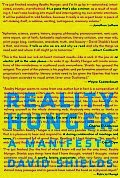
David Shield’s Reality Hunger: A Manifesto had me riffing on its provocations. Like any good book of philosophy, this one forces a reader’s reaction. The numbered paragraphs are widely borrowed from attributed sources and compiled to construct a number of dubious arguments (the novel is dead, “sampling” is the future of literature, truth is more worthwhile than fiction). Nevertheless, the resulting compendium is provocative for the daring of the broad sampling ( a preponderance for several quotable essayists), often rewritten to make Shield’s points, which proves or at least validates that his de-contextualization experiment might just be a hybrid form of memoir-slash-manifesto. Though it also provides a convincing case that the novel is alive enough to provoke diatribes against it.

The Letters of Samuel Beckett, 1929-1940, are almost too specific, direct and intimate, like catching one side of an eavesdropped conversation, that a guilty taste of voyeurism is unavoidable. What comes through the young Beckett’s missives is a hubristic certainty, a kind of unassailable arrogance, as well as an authority tempered by doubt and perseverance, as when he declaims to his cousin Morris Sinclair: “Here I strut about, I cannot and will not do otherwise, and have no idea if God helps me or not.” One would have been honored and maybe intimidated to have received from Beckett a multi-lingual letter laced with multiple literary references. But even a partially committed Beckett completist will be curious to thumb through this first of four projected volumes for prime examples of an endangered, if not yet extinct, form of writing from a modern master.

Thursday, April 8, 2010

Reality Hunger's Discontent

The death warrant for the novel always seems to be a celebration. Literary forms grow and transform over time; undeniably, the novel may be the most open, enigmatic and constantly challenging of forms. Why would there be a need to pronounce the novel dead if it wasn’t in fact alive and well? One rarely hears novelists proclaiming the end of the memoir, or the end of poetry.
In fact, so often people have a vehement dislike for and anger towards “the novel”--to which I often think: what did the novel ever do to you? Because it is a difficult form that defeats. Maybe what ultimately defeats is a lack of commercial success.

The benchmark of commercial viability is difficult to come by. Only a few books make it to the darling list. One of the results of this is the attempt to invent a new form. Another is to go meta.

Because the form has existed for so long, so effectively, and in light of technology, it seems viable to question the novel’s means and methods are no longer relevant or somehow wanting. Experimental writers take this up as a badge of honor, subverting narrative in the “traditional” sense (The failure to play the commercial game is to buck tradition, to deny what a marketing machine expects and searches for).

To identify a benchmark as baseline is usually the best most writers can wish for; then, to remain undaunted in the long haul of writing a novel, to say nothing of writing one of originality, is a meager dream. This might explain the proliferation of that type of novel that people supposedly want to read, the block buster, which is usually anti-original, formulaic, genre work.

To imagine that anyone is so in love with “reality” or aching for it, we have reality TV programming. But don’t imagine that those reality narratives aren’t shaped into some from of drama in the editing room (to lesser or greater effect--I’m willing to bet that among the writers on those programs is a novelist or two).

Without the anointment of commercial success, and having failed to live up to the demands of the form, so called re-invention is necessary. This is also known as a good career move.

David Shield’s Reality Hunger appropriates samples, sound bites, other writer’s pithy phrases out of context, and re-contextualizes them. He is utilizing the plagiaristic taboo writ large. This is the nature of the web having its influence on publishing. As with blogs, there is so much work to reference and draw from, to lead the reader to more and more information. One has to get read. The present horizon of the mobile text (the ephemeral written word on the web) means the writer can’t count on anyone getting that far into any one particular book. Yet Reality Hunger is a book, not an online text.

Reality Hunger as a text is a great idea. The style is a gimmick that provokes, seizing on the controversial aspects of recent memoir scandal (the appropriating element), as well as wrecking the house on the way out the door (the death of the novel element). But I won’t call it art.

Providing an antidote to an imagined problem is a proven marketing ploy, its effectiveness is a foregone conclusion once the publisher rallies behind it. Whatever the form of Reality Hunger is, it will never replace the novel.

Wednesday, March 17, 2010

Death Of Craft

There seems to be a lot of hand wringing and grief over the end of publishing in its traditional form. If you doubt you had a stake in it to begin with, it becomes easier to embrace the changes. I still don’t quite know what any of this means to me as a writer, but I’m worrying a lot less about what will come of it. And I’m glad to see that the book will never die. Maybe this should be considered the beginnings of a renaissance.

That writers can’t/won’t any longer make money from their work is considered inevitable. Journalism is becoming devalued. An untenable practice. The gist of this scenario is the fear that one’s work will become too easily copied, or reproduced (read: stolen) or worse still, evaporated into digital ether.

Rather than fret with Y2K type doomsaying, I’d rather see concern about craft. Until someone wants to read the work, fears of a plagiaristic public or “the end of cultural civilization” is off the radar.

I can see the day where craft might seem like it is no longer relevant. Is it wrong to say the writing is on the wall? (insert favorite mobile technology here.) There’s just too many voices clamoring to be heard (and voices here is as much the bloggorhea, the instant message which strains to be relevant). I trust I’m not alone in the dogged pursuit of craft. Even as much as the blog has an instantaneous thrill, I still insist thoughts committed to paper gestate before they appear here.

For all the immediacy of technology, the presumed benefit it offers an unheard of writer, I still avoid most of the technology whose expediency is largely useless to me. Had I had this technology available to me fifteen or twenty years ago, I think I would have been less wary, but I’m more interested in saying something useful or enlightening, rather than just chattering away on any old subject. I imagine that’s the case for a lot of writers who consider writing an art form.

On the optimistic side, the clamor is bolstered by the directives that getting published has become so commonplace as to be considered “easy.” But it’s not that easy. Not if you are trying to place your work where it might actually be read.

The all consuming needs of technology seemingly make it easier for more people to have a voice. The proliferation of voices implies there are more voices that want to be heard, and thus less with anything to say, or at least, less with any distinction. To which my immediate concern is an Orwellian death of craft. But the practice of writing has not been rolled under the bus. The tools of technology should not be imagined to have usurped craft.

I'll continue to be concerned with relevance, and craft. Relevance is in trying to get to truth, and to say what’s important. Being able to say that because it’s important to me, I trust it might also be for someone willing to read me.

Maybe this is the future, right here.