Friday, April 30, 2010

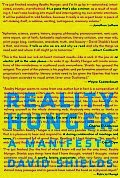
Reality Hunger Refraction*

1-618.

Drawing from so many varied sources as Shields does, there is the question of, curiosity about, insistence upon, authority.

139.

Writing fiction has little to do with telling someone how to live their life, or attempting to show them how, nor in edifying. It is a compulsion for turning out a possible reality, in words. (Maybe that should be, a variation of reality, or a supposition of reality, or just, a fiction.) It seems inherently material: words are tools, words are the medium. Words are the prime medium because they are where the point is put across.

143.

In architecture school, I recognized this truth: limitations give me freedom.

182.

Plot often comes out of a work incidentally. I'm thinking of statements such as: "She was in the park watching the men cut the grass." In the narrative convention, one expects and usually gets that something comes next, a further development and detail. A built-in anticipation, a narrative, a plot, drives the telling onward.

192.

John Cheever mined exhaustively from his life for hundreds of stories, and several novels, and no one ever questioned that it was anything but fiction.

193.

Truth doesn't reside in what happened, but how we come to frame what happened.

199.

When I first saw Chris Marker's Sans Soleil, I thought it was a documentary. A voice over of a woman reading from the dispatches of an itinerant anthropologist. But it occurred to me after the second viewing that these letters were a fictional device.

261.

Fiction doesn’t condone wholesale plagiarism, which would not be called sampling, because such literature is considered a deliberated work of intellect. The simplicity of its expression means the component parts are the whole of the thing. In general, literature is a one person show (usually). A work of literature is not multi-layered, thus it is far easier to appropriate illegally, and less recognizable when it is done.

276. To put it another way: Literature has the most worked out d.i.y. ethos next to your neighbor’s garage band, but neither is your neighbor’s band going to become as big as the Beatles, nor will P. Diddy be sampling them.

283.

An interesting form could come out of, for example, “take the seventh line from the 92nd page of the first five books on your shelf with “The” in the title.”

319.

I think plot is mostly a result of narrative. The concession I make toward plot is because it is usually demanded, and I am likely to admit, “I did not plot.” The basis of the demand is an inability to embrace something different, hybrid, open.

321.

Does story necessarily seem to say everything happens for a reason? It is questionable to take only the strictest and literalist of terms for what anything is.

324.

Plot, in the most compelling works, is almost residual. Cortazar’s Hopscotch; Beckett’s Molloy, Malone Dies, The Unnamable; Bernhard’s On A Mountain; Carla Harryman’s Gardener of Stars; Bolano’s 2666.

384-397.

The closer one gets to genre, the more over-determined the prose vehicle becomes: genre=anti-art.

420.

We characterize fiction as an escape (and that this is somehow bad?), but isn’t that more an escape for the reader? Isn't there an equivalent escape for essay and memoir?

456.

I craft for myself first, for an interested reader, second.

503.

We aspire to life as art because when it’s done masterfully, that’s what it looks like.

540.

Doubting myself one day, a friend edified me with my predicament (and paid me a high compliment): “You’re a painting, man. You’re a fucking Rauschenberg.”

601.

In the naïveté of my writing apprenticeship, I assumed the goal of writing fiction was to strive to write something beautiful. I’ve come to see the goal as a combination of an artistic and aesthetic expression that aims at truth. The result will ultimately alienate some, and provide frisson, for others. So, it has more to do with truth than beauty, though that can be beautiful in itself.


NOTES:

*I’ll admit, I was prepared to despise David Shield’s Reality Hunger: A Manifesto. Yet what’s so compelling is the ground covered in advancing an idea that I don’t in any way agree with (more or less, that “the novel is dead”). The ideas are presented in such a way that makes me think about the process of writing, and in so doing, made me manifest a bit myself (It is “a manifesto”). The book feels like a microcosm of how writing is about assimilating information and thinking on the page. Thus my review here is a reaction, a refraction, and a reflection. I have responded to a selection of the numbered segments (there are 618 in total) in the body text of Reality Hunger; the subsequent footnotes indicate the reference number and a facsimile of the text, or the complete text, whichever I found easier to crib from, in the book’s appendix. In the spirit of the book, I’m also playing fast and loose with attributions. If you want to see them in full, you will have to look at the book.

139. “In the end, I missed the pleasure of a fully imagined work in which the impulse to shape experience seems as strong as the impulse to reveal it.”

143. The notation refers to the Dogme 95 manifesto, which Shields quotes at length.

182. “For example, in Proust, who is to me at base an essayist, nothing ever happens. The only obstacles are that someone might rebuff someone else or someone might get sick or grow old, and even these are usually hypothetical obstacles. People get educations, travel, buy paintings, go on diplomatic missions, but the events are for the most part meetings between various people (or simply sightings of one person by another, sometimes thanks to a stroll or a ride in a carriage) and what these meetings being out on a psychological level, about life itself. How can a work be considered fiction when there's no plot? Philosophy, perhaps, or criticism, but not fiction.”

192. “The line between fact and fiction [...]” Raban

193. “[...] Just what is the relation of your memoir to the truth? It is as close as it can be. The moment you put pen to paper and begin to shape a story, the essential nature of life--that one damn thing after another--is lost.” Dorothy Gallagher, “Recognizing the Book That Needs to Be Written,” New York Times.

199. "[...] The border line between documentaries and feature films is blurred; in fact, it doesn't exist." Werner Herzog

261. Art is theft

276. Sampling, how rappers get the MC name.

283. A literary equivalent of sampling.

321. “Story seems to say that everything happens for a reason, and I want to say, No, it doesn’t.” Shields.

324. “The absence of plot leaves the reader room to think about other things.”

384-397. Various annotations on genre

420. “[...] I most admire those books that not only enable me to endure life but show me how they got there [...]”

503. “Everything in life, turned sideways, can look like--can be--art. Art suddenly looks and is more interesting, and life, astonishingly enough, starts to be livable.” Shields.

540. “Anything you do will be an abuse of somebody else’s aesthetics.” Rauschenberg.

601. "Beautiful Illusion."


Friday, April 23, 2010

Feast Of Excess

There is a notion that a novel has to be as healthy and bland as kale or else it isn’t literature. As if the unspoken rule is that it must only be sternly serious and if it happens to be enjoyable, then that must be an oversight on the writer’s part. This seems to be the root of a lot of the criticism of Ian Mc Ewan’s Solar, for what it is not.

That Mc Ewan’s novels are elaborately constructed marvels of prose and entertaining is a testament to his skill. (This could be lost on this NYTimes book reviewer.) If Solar does not reach the same high watermark that everyone was expecting after Atonement or On Chesil Beach, the writing is the epitome of Mc Ewan’s stylistic precision. Still, Mc Ewan is going for a laugh any time he describes a glutton’s eagerly anticipated meal:

“She took away the bowl with the three cold lozenges and set the main course down before him. Four wedges of skinless chicken breast interleaved with three minute steaks, the whole wrapped in bacon, with a honey and cheese topping, and served with twice-roasted jacket potatoes already impregnated with butter and cream cheese.”

Solar is an indulgent feast of satire.

Solar harkens back to the style of Amsterdam, operating in a comedic-tragic register which also recalls the bold mischief of Mc Ewan's early short stories. There, the characters are young and depraved, making sense of the world from a limited understanding of it. What those life lessons earn the protagonist of Solar, Michael Beard, is a deficit; forever after he will go to extremes to avoid humiliation at the hands of an associate, using whatever vengeance at his means, getting away with whatever he can. Youthful curiosity and glory is eventually replaced with the fading returns of post-middle-age survival. Beard isn’t a character easy to like, but he seems prototypically human, and it is as easy to laugh at him as it is to have hope for him in his failings.

Mc Ewan wallows in Beard’s excesses. This is the opposite of the life-saving and affirming protagonist in Saturday; Beard is a man who on the face of his accomplishments (Nobel Prize winning physicist) might be enviable, but is flailing with a dangerous lack of scruples. Maybe the degree to which a reader is willing to follow this reprehensible character is how much he or she recognizes the folly of human endeavor.

Self-consciousness drives Mc Ewan’s protagonists; he has consistently perfected the limited third person point of view, or, as James Wood has it, free indirect style. In particular, this consciousness allows Mc Ewan to confront moral quandary and force the character to interact with their world on a finite scale. The depth of this consciousness can be almost uncomfortably perverse and unbridled, backed up by the scientific mind that allows Mc Ewan to focus in on the protagonist’s whims with a dissecting knife. That this consciousness is rendered in more depth and literary-ness than the person having the experience would probably have is playing to the satire.

The rendering of Beard’s gluttony is anachronistic, almost indecent details applied to a novel of a lofty and timely subject (Global warming). The effect is ornate overstatement, words larded on because Mc Ewan can, that feels defiant--in a sense, he’s showing off--but it’s a sure-footed, often hilarious, touch.

Much of the narrative of Solar relies too readily on the withholding of information. In a more high minded work it might be considered manipulative, but this is light treatment of a heavy topic. The problem for Mc Ewan is taking a subject too earnestly and becoming heavy-handed, bogged down in technical jargon and plot machinations as he did in Saturday. In Solar, he applies his research to make the stakes relevant, though the reader may find that these stakes are largely misconstrued. Beard is the center of his own universe.

Solar begins tentatively, with a back-story summary, though this exposition provides signposts for the novel’s departures. If a novel is a journey, there are enough clues from Mc Ewan that the reader will be taken on an adventure. And ultimately, Solar achieves what a novel should, engaging the reader in a world that suspends in wonder, be that wonder at the skill of the writer, or at the anticipatory pleasure of what is to come. The repast can be a feast to binge on, or a satisfying meal to savor. It’s all good.

Friday, April 16, 2010

A Beautiful Necessity

"What I know about writing I know from having read the work of the great writers." So says Richard Bausch in The Atlantic, regarding his one foray into contributing to an ill-fated how to collection of essays in which his work was unceremoniously left out.

I think the impulse to offer how to advice is as much out of reminding oneself how it is done, as a form of practice; if someone finds it useful, so much the better. What I like in Bausch's attitude is that he makes explicit what I assume, in my good nature or goodwill, is everyone's motivation. Of course this is naive. I suspect there are millions of people for whom writing is not derived from "a kind of beautiful necessity."

Wednesday, April 14, 2010

McEwan On Process

Ian McEwan, during his visit to San Francisco to promote Solar, was on KQED’s Forum with Michael Krasny this morning, and he responded to a few questions I asked about craft and process. I’ve transcribed his compelling response here:

“My important bit of process is hesitation. If I get an idea, I sit on it. I don’t do anything with it. If it’s a good idea on Monday, it better be a good idea three Mondays later. And often it isn’t. What can seem like a fantastic idea one end of the week, will fade by the other end. So I am a great hesitator, I pause, I brood. Sometimes I don’t even allow myself to take notes about a scene that I’m going to write because I don’t want to start crystallizing it into words. So I carry a lot around in my mind. I am someone who can sit by the delayed luggage carousel for twenty-five minutes quite happily just turning over the stuff that’s there; I don’t need a notebook.

On the other hand . . . I’m a great one for writing the opening paragraph for novels I need never actually complete. Knowing I don’t have to write them confers a great deal of freedom on me. And I’ve started one or two novels that way recently, just idly turning out a sentence or a paragraph that intrigued me.”

A link to the full audio mp3 of the program is available here.

Sunday, April 11, 2010

McEwan Over London

"Whichever direction his gaze fell, this was home, his native corner of the planet. The fields and hedgerows, once tended by medieval peasants and eighteenth-century laborers, still visibly patterened the land in irregular quadrilaterals, and every brook, fence, and pigsty, virtually every tree, was known and probably named in the Domesday Book after all-conquering William in 1085 conferred with his advisers and sent his men all over England. And ever since, named again with greater refinement, owned, used, costed, traded, mortgaged; mature like a thick-crusted Stilton, as richly stuffed with varied humanity as Babel, as historical as the Nile Delta, teeming like a charnel house with ghosts, in public discourse as dissonant as a rookery in full throat. One day this brash and ancient kingdom might yield to the force of multiple cravings, to the dreamy temptations of a giant metropolis, a Mexico City, São Paulo, and Los Angeles combined, to effloresce from London to the Medway to Southampton to Oxford, back to London, a modern form of quadrilateral, burying all previous hedges and trees. Who knew, perhaps it would be a triumph of racial harmony and brilliant buildings, a world city, the most admired world city in the world.

How, wondered Beard as his plane at last quit the stack on a banking hairpin tangent and lined itself up north of the Thames to begin its descent, could we ever begin to restrain ourselves? We appeared, at this height, like a spreading lichen, a ravaging bloom of algae, a mold enveloping a soft fruit--we were such a wild success. Up there with the spores!"

Thursday, April 8, 2010

Reality Hunger's Discontent

The death warrant for the novel always seems to be a celebration. Literary forms grow and transform over time; undeniably, the novel may be the most open, enigmatic and constantly challenging of forms. Why would there be a need to pronounce the novel dead if it wasn’t in fact alive and well? One rarely hears novelists proclaiming the end of the memoir, or the end of poetry.
In fact, so often people have a vehement dislike for and anger towards “the novel”--to which I often think: what did the novel ever do to you? Because it is a difficult form that defeats. Maybe what ultimately defeats is a lack of commercial success.

The benchmark of commercial viability is difficult to come by. Only a few books make it to the darling list. One of the results of this is the attempt to invent a new form. Another is to go meta.

Because the form has existed for so long, so effectively, and in light of technology, it seems viable to question the novel’s means and methods are no longer relevant or somehow wanting. Experimental writers take this up as a badge of honor, subverting narrative in the “traditional” sense (The failure to play the commercial game is to buck tradition, to deny what a marketing machine expects and searches for).

To identify a benchmark as baseline is usually the best most writers can wish for; then, to remain undaunted in the long haul of writing a novel, to say nothing of writing one of originality, is a meager dream. This might explain the proliferation of that type of novel that people supposedly want to read, the block buster, which is usually anti-original, formulaic, genre work.

To imagine that anyone is so in love with “reality” or aching for it, we have reality TV programming. But don’t imagine that those reality narratives aren’t shaped into some from of drama in the editing room (to lesser or greater effect--I’m willing to bet that among the writers on those programs is a novelist or two).

Without the anointment of commercial success, and having failed to live up to the demands of the form, so called re-invention is necessary. This is also known as a good career move.

David Shield’s Reality Hunger appropriates samples, sound bites, other writer’s pithy phrases out of context, and re-contextualizes them. He is utilizing the plagiaristic taboo writ large. This is the nature of the web having its influence on publishing. As with blogs, there is so much work to reference and draw from, to lead the reader to more and more information. One has to get read. The present horizon of the mobile text (the ephemeral written word on the web) means the writer can’t count on anyone getting that far into any one particular book. Yet Reality Hunger is a book, not an online text.

Reality Hunger as a text is a great idea. The style is a gimmick that provokes, seizing on the controversial aspects of recent memoir scandal (the appropriating element), as well as wrecking the house on the way out the door (the death of the novel element). But I won’t call it art.

Providing an antidote to an imagined problem is a proven marketing ploy, its effectiveness is a foregone conclusion once the publisher rallies behind it. Whatever the form of Reality Hunger is, it will never replace the novel.

Wednesday, March 17, 2010

Death Of Craft

There seems to be a lot of hand wringing and grief over the end of publishing in its traditional form. If you doubt you had a stake in it to begin with, it becomes easier to embrace the changes. I still don’t quite know what any of this means to me as a writer, but I’m worrying a lot less about what will come of it. And I’m glad to see that the book will never die. Maybe this should be considered the beginnings of a renaissance.

That writers can’t/won’t any longer make money from their work is considered inevitable. Journalism is becoming devalued. An untenable practice. The gist of this scenario is the fear that one’s work will become too easily copied, or reproduced (read: stolen) or worse still, evaporated into digital ether.

Rather than fret with Y2K type doomsaying, I’d rather see concern about craft. Until someone wants to read the work, fears of a plagiaristic public or “the end of cultural civilization” is off the radar.

I can see the day where craft might seem like it is no longer relevant. Is it wrong to say the writing is on the wall? (insert favorite mobile technology here.) There’s just too many voices clamoring to be heard (and voices here is as much the bloggorhea, the instant message which strains to be relevant). I trust I’m not alone in the dogged pursuit of craft. Even as much as the blog has an instantaneous thrill, I still insist thoughts committed to paper gestate before they appear here.

For all the immediacy of technology, the presumed benefit it offers an unheard of writer, I still avoid most of the technology whose expediency is largely useless to me. Had I had this technology available to me fifteen or twenty years ago, I think I would have been less wary, but I’m more interested in saying something useful or enlightening, rather than just chattering away on any old subject. I imagine that’s the case for a lot of writers who consider writing an art form.

On the optimistic side, the clamor is bolstered by the directives that getting published has become so commonplace as to be considered “easy.” But it’s not that easy. Not if you are trying to place your work where it might actually be read.

The all consuming needs of technology seemingly make it easier for more people to have a voice. The proliferation of voices implies there are more voices that want to be heard, and thus less with anything to say, or at least, less with any distinction. To which my immediate concern is an Orwellian death of craft. But the practice of writing has not been rolled under the bus. The tools of technology should not be imagined to have usurped craft.

I'll continue to be concerned with relevance, and craft. Relevance is in trying to get to truth, and to say what’s important. Being able to say that because it’s important to me, I trust it might also be for someone willing to read me.

Maybe this is the future, right here.

Monday, March 8, 2010

Return To Form?

I’m getting ahead of myself before I’ve even had time to read the new Banville, but I enjoyed what Maureen Corrigan had to say on Fresh Air in her review of The Infinities:

“I used to put a lot of stock in an adage about writing. It went roughly like this: "If a student says he wants to be a writer because he has something to say, discourage him. But if a student says she wants to be a writer because she likes to play around with words, well, that student may have what it takes to be a writer.

I don't believe in absolutes about writing anymore: People write out of all sorts of longings and take many roundabout paths to producing good books. But I thought of that axiom as I was reading John Banville's new book, The Infinities.”

I usually find her gloating reviews annoying, but this time she’s whetted my appetite.

Sunday, March 7, 2010

The Coetzee Reduction

The affinity with Beckett, though not always obvious, is apparent in Coetzee. His work often feels like it is attended to by lab coated technicians. This precision in Coetzee might make his writing dull for some readers, but clean prose is appealing. In the kindest sense of the word, this sterility keeps the words measured, never wavering in pitch. He is writing from his own register, untouched by any other writer, and untouchable. This is the uniqueness of voice; it’s a quality of the writers I can count on one hand who I secretly admire but can’t quite admit that I love. (Does love of a writer equal a desire to want to emulate the writer?) This voice elevates Coetzee above the merely functional writers far and wide. But voice doesn’t necessarily make one adored.

In Summertime, the surprise of the author writing about himself and calling it fiction sates a prurient fascination, and yet we are aware he is not writing strict autobiography; in fact, the Coetzee in Summertime is dead. The stature of the real Coetzee imposes a Zelig-like quality in the narrative, and it’s conspicuously his thoughts on what others might think about him as the prodigal returning to shock them (Coetzee’s femmes) from their comfort zones. By absenting himself, he is everywhere.

As in Elizabeth Costello and Slow Man, Coetzee frames this narrative of a self-referencing narrator within the story. Coetzee takes this a step further, imposing a mental puzzle on the narrative that calls into question the layered self-referencing. It is one thing to refer to your earlier pseudo-autobiographical self as “he,” as in Youth, but when a narrator transcribes another character’s words back to her as “she,” complete with running editorial from this subject character, there are intrusions that feel like a fold in the brain:


“In the Standton set in which she [Carol] and Klaus move, she confides, quite advanced things go on. She does not spell out what these advanced things may be, and she, Margot, does not want to ask, but they seem to have to do with sex.

I won’t let you write that. You can’t write that about Carol.

It’s what you told me.

Yes, but you can’t write down every word I say and broadcast it to the world. I never agreed to that. Carol will never speak to me again.

All right, I’ll cut it out or tone it down, I promise. Just hear me to the end. Can I go on?

Go on.

Coetzee’s dialogue blanches with the moral indignation that feels Doestoyevskian: there is no urge for the put upon character to resist saying what everyone wants to ignore.

In Coetzee there is a lack of adornment. His writing might be the stripping away of all poetic language (or what I mean by this loose term for inflated, purple, adjective laden writing), so that what is left either zips along for you or it violates a cardinal rule of the creative writing manifestos (“show don’t tell”). Coetzee writes psychological prose. But it’s not describing a lot of action, it’s more of thought and gesture. The style is a discursive and projected thinking on the part of the character.

Writing consciously in this vein--and Coetzee is never an unconscious writer; self-conscious, yes--rolls the story forward. One doesn’t dwell and linger; the lack of modifying words drives the narrative because Coetzee has already distilled the prose to a reduction, and it’s necessarily succinct.

Thinking about Coetzee, after reading him, is almost a gray wash. It becomes difficult to recall specific moments in his work, or why they make an impression. But I find reading him is like settling into a highly engineered piece of machinery--even when I might have the hesitation of doubt, however brief, I’m soon rocketing back into the stream of the writing. I have come to trust him. There is a compelling consistency in his writing, like religion. Or from the words of a character in Summertime: “As a writer he knew what he was doing, he had a certain style, and style is the beginning of distinction.”

Thursday, February 18, 2010

Books Once Loved

The idea that I can’t love a book forever feels despairing to me. Or formative.

There are a handful of books I claim to love. So it’s odd to go back to them. Does the love fade, or did my taste change, or is a book love good only for one brief moment in time? Mating, by Norman Rush, is feeling like that. When I first read the novel in 2001 or so, I remember feeling a lot more giddy with the book--the classic recognition that the book was written for me. That idea is fast approaching a cliché--but this is how I feel when I find a book I can’t wait to keep reading--only hoping it won’t end. Re-reading Mating now, though I can see what is compelling in the writing, I also find the first person narrator too self-conscious at times, the writing clever in the manner that I’ve been criticized for, and am now, post-MFA, overly conscious about.

As much as I enjoyed and was sucked into Dan Chaon’s Await Your Reply, at the end of the book, I wasn’t as in love. The prose is crafted but doesn't attain an untouchable category for me. The novel is certainly well plotted, and masterfully executed, but the prose is largely getting from point A to point B. There isn’t much that I take away from the characters or the prose that will stick with me.

And maybe that’s the point: the love has to take hold from the start. At the end of Chaon’s book, I thought, it is good, perhaps even brilliant. I could learn from this book. But do I want to re-read it again? Doubtful.

The beloved category books work a magic that is maybe from a combination of where I was in my life when I read it, and as much from what I brought to the work.

For awhile now I’ve been disabusing myself of the notion that I can go back to the books I once loved and feel the same frisson all over as if I hadn’t read dozens if not hundreds of book since, enough to have altered my tastes and views (as well as what time will effect) so that I could never go back and find the same experience again of a book.

But as I’ve been finding fewer new books I’m eager to read, I’ve become so desperate that I’ve even gone back to ones I read a year or two ago and really liked, if not quite loved, and re-reading them. The trouble with this practice is that I still know the story too well, and so I have to look for something else to draw me into the narrative. Often then, I get caught up in the surface (having glided across it, perhaps, initially). Because if the surface isn’t smooth, or is reflecting something I didn’t notice before, suddenly that’s all I see. I might forget the depth I easily found in the first read through.

This is not a definitive list, but among the handful of books I’ve gone back to and found richer and more rewarding the second or third read--and that I loved from the start--would be The Lover by Marguerite Duras, and The Sea by John Banville. (I eagerly await Banville’s The Infinites, which is being touted as a return to form, which I welcome.) I’d add to this Saul Bellow’s Adventures of Augie March, Philip Roth’s Sabbath’s Theatre, and Julio Cortazar’s Hopscotch. Most of Beckett’s novels I can re-read forever, too.

Still, maybe the idea that that book love is unchanging is one best jettisoned. Why would I ever need to keep trying to find the next one, otherwise? I may say, “This is a perfect book,” or, “I loved it,” but maybe that’s just infatuation.

Friday, January 1, 2010

Two Thousand Ten

The saying, “Do what you love and the success will follow,” is always one I’ve heeded, religiously. Primarily because my priority is to do work that I enjoy since I’m going to spend so much time doing it. Writing has certainly led this call for me, though after years of practice, the hankering for further extrinsic reward is undeniable. I’m not sure if that’s necessarily financial as some think it is. It is about public acknowledgement, perhaps, though the numbers of beloved artists who are satisfied with their work are probably equal to those that are dissatisfied.

I often wonder about motivation for my fellow writers--I don’t get people who want to write because they want to make a best seller list (which seems equal to thinking you could win the pick six). I don’t get people who want to write though they don’t like to read. It’s as if everyone wants to be a writer, as if it’s been glamorized beyond recognition. For the longest time, everyone wanted to be an architect, or at least this is how it was reflected in Hollywood screenplays.

I know that, in 2010, I’m still deepening my practice, I’m still learning and loving the work, the craft on the page, the music and conceptual frisson that can be found, and deployed, in a long work of fiction. It’s the life of the mind, still, just as it was for me seventeen years ago. I don’t expect a huge success, but the incremental one has been encouraging and rewarding. I’m reminded of when, four years ago, my college advisor tried to level me a bit with what he presumed to be my false ambition; no matter what, I still appreciated that honest advice, though his cautionary reaction was more fitting advice to someone who hadn’t struggled at something that he was going to do no matter what reward he got out of it.

No matter what one talks about in the pursuit of a writing career, there is no field I know that has so many naysayers who don’t want you to have this thing you are passionate about on your terms. Unfortunately, these are often the gatekeepers; fortunately, they’re not all naysayers. All of these naysayers can’t take the love of the writing away, and I’m confident I’ll outlast so many of them that I won’t eventually care anymore.

Happy 2010!

Tuesday, December 22, 2009

Esteemed Nicaraguan Novelist

My review of Sergio Ramirez’s A Thousand Deaths Plus One is in the new print edition of Rain Taxi:

"[...]The two short stories that open each half of the book link the cultural figures (in the novel) and provide a skein of themes that the novel elaborates upon . . . Ramirez channels a style similar to what W.G.Sebald conjures in his works of remembrance and soi-disant history."

Here is the link to the actual review.


Saturday, December 19, 2009

Character, Not Plot

"I feel strongly that action is generated out of character. And I don't give anything a higher priority than character. The one consistent thing among my novels is that there's a character who stays in my mind. It's a character with complexity that I want to know better." --Marilynne Robinson (Paris Review Interviews, IV)

Saturday, December 12, 2009

Gravy. Or Icing.

Flaubert suffered for his art. Why does this seem disingenuous? Is it really believable that Flaubert approached his writing so detached from the end results, as indicated by the entries that Barthes quotes in his essay, “Flaubert and the Sentence” (New Critical Essays)? For example, Flaubert writes: “...I don’t want to publish anything...I work with an absolute disinterestedness and without ulterior motive, without external preoccupation...” It’s the hindsight of those quotes, the literary pillar that Flaubert eventually achieved, that make them seem bold, the fly in your face convictions of a rebel. The last one I quoted was written when he was 25, before he had achieved any measurable success. Flaubert, libertine and bon vivant extraordinaire, had what seems a cushy life in which he did as he chose--and probably paid for it, too. And he wrote with some conviction, and passion.

Publication, though maybe not the end result of passion, in some way helps ensure it. Far from having major success, however, how many writers spend years without any idea if anything will come of the work? Maybe there is a keener knowledge that in fact if one toils long enough the learning curve could suggest that they might come to know at least “how” to get published, or why a piece can get selected or not. Like any set of rules, if one can follow them enough (conform, to be more precise), and manage to offer something with originality or spark that can touch a nerve, or tap into the collective consciousness, perhaps, they are already ahead in the game.

But to go back to Flaubert. The error in retrospection is to say the author knew what they were heading toward--fame, or public recognition. There are legion writers who struggled and suffered for their art--and maybe this idea has been overplayed. Maybe masochism is a point of pride in literary production. Think of Doestoyevski, and his life; on the other hand there’s Tolstoy--though I’ve been made aware his life wasn’t all comfy at the end. But then Beckett, who worked so hard to achieve what he did but, from the evidence, didn’t enjoy the fruits all that much.

Years ago, I believed I was suffering for my art (writing), but was really suffering for reasons that had nothing to do with writing. Does this lessen the possibility that I’m creating anything of lasting value now, since I don’t feel like it is such a struggle anymore--or that the struggle isn’t so much about the art as it is a sense of legitimacy?

There can’t be any certainty, period, about literary posterity. Why bother. One should just do a good job for the same reasons they would do anything with love, skill and proficiency--because that way of working carries an intrinsic reward. Along the way, perhaps if you are lucky you figure out how to live while you’re at it, and how to live well, even, because in the end you’re not going to see what comes seventy years from now anyway. The rest, is gravy. Or icing.

Sunday, November 29, 2009

Writing Every Day

The first thing people have been asking me when I mention the novel I’m working on, is, “Do you use an outline?” I have an unpleasant visceral urge when I hear that word because I’m reminded of many years ago in school when we were told to do an outline for our essay that was supposed to be based on this pyramid thing which I won’t even try to explain as it’s probably ubiquitous for anyone who’s been part of the American educational system in the recent past. (I don’t know what they use now. I don’t doubt the pyramid is still in use. There’s something structurally sound and formidable about pyramids; it’s not entirely clear that that applies to the products that imitate it, however.)

I don’t know if I’d write if I couldn’t surprise myself with what I write. For me, an outline becomes a foregone conclusion. Maybe the outline I use is an amoebic idea in my head. Maybe I’m kidding myself, but realistically, I can never really know what I’m going to write until I write it.

If I try to write the idea down without actually writing the totality of the thing (in other words, actually writing down the scene that I have the idea for, rather than the shorthand of the idea), I may never write it. It’s best for me to start writing.

I grew up with a terrible unease about writing and my abilities as a writer until college and the passion for reading took over, but by then I believed I wasn’t a writer, even though I admired writers. I wasn’t yet able to imagine myself as one.

Interregnum: years in an architecture practice (of the building kind) that now funds a writing career. Success?

Perhaps.

I was trying to explain to a friend the other night that for me, writing is now alchemical. I have spent enough time with words and in school hashing over words that they are in my blood. There’s a point where things topple over into a realm that I can’t rationally explain. Maybe this is what the best writing ultimately achieves. I think about the ten thousand hours notion, and am pretty certain I’ve done my ten thousand hours. (This is of course Malcolm Gladwell’s idea.)

I need sufficient disorientation to have to write my way out of something. In my daily writing practice, I find that I can cover ground I didn’t plan on covering because my approach relies on a fair amount of misdirection, intuition and perhaps mysticism. There’s a great moment of reading something over months later and not remembering that I wrote it. It’s even better when the work gets published; though I usually see things wrong, just as often I find things that I’m surprised by.

Tuesday, October 6, 2009

A Novel Detour

The reason for my absence from here: I’ve been working on a new novel, the first I’ve started since finishing my MFA three years ago. What I decided to do differently this time is largely about process, avoiding the pitfalls of my past forays into the novel. I think the MFA practice was useful because it forced me to think about producing writing, if not every day, at least weekly. My practice now is to write for at least one hour every day, usually in the morning. The goal is to produce at least two manuscript pages (or about 500 words), but on really productive days, I can write three times that amount. I find that the discipline, even in the face of limited inspiration, will yield results. After all, the daily production, since it is part of a larger piece, doesn’t necessarily have to make it into the novel. Since August 8th I’ve written perhaps 200 pages (The actual number is about 20,000 words per month; that’s two, fifty page legal pads per month--I’m just enough of a Luddite to write long hand). The ultimate goal is to produce a 100,000 word draft of the novel which I hope to have by the end of November. Then I’ll undertake the long effort of taking it apart, re-writing, re-shaping, and structuring the novel.

An hour per day. That’s it. I can work more on it if I want, but I often find I’ve said my piece in the bit of writing I did and I don’t want to force it. On some days, it is hard work, there is a feeling of forcing it. But sometimes even that bit of writing can lead to some new angle on character.

I came to this approach from writing short stories more or less religiously over the past three years. In my process for a short story, I came up with an interesting idea and explored it in writing. I wouldn’t usually rework the draft until I had a quantity (usually two or three thousand words, maybe more) to work with. I’m counting on this with the first draft of the novel. After a few weeks I find I’ve forgotten what I wrote a month ago, and I’m often surprised by where it takes me.

So much about being a writer is, like any job, “showing up”--I’m sure this sounds like the most obvious comment, but it’s true. You have to face the blank page every day and begin to put words down, however arduous, however difficult. What finally made me decide to work on a novel is that an interesting idea from a short story I had written suggested it, and once I began writing, a series of characters came to life. Once characters are in my head, they usually won’t go quietly.

Monday, June 22, 2009

Wisconsin Review Publication


At long last the Spring 2009 issue of Wisconsin Review is out, where my story “The Edmonton Farrell” can be found. Here’s the link to their page where this wonderful journal can be ordered.

Saturday, June 20, 2009

Writing And Empowerment

I have always known and accepted for myself that a high standard is the only one I'm interested in pursuing. Short of getting a message out (what this blog attempts to do), writing--fiction in particular--should aim to be art.

I don't think this is so for the general population of wanna-be writers, a group I no longer include myself in. I think, because of the fame that is sometimes attached to the writer, this is the reason some people pursue it, maybe even the only reason. The fallacy and folly of this idea is well stated here, in a blog entry from the Guardian.

I've always believed that my work is going to be recognized, someday. At this point, that could sound like I expect fame and success--on the first count, I don't; on the second, I think I have found success. I simply believe that being committed to one's art is a very salutary thing. It allows me to practice more in the Buddhist sense of the five powers: faith, diligence, mindfulness, concentration and insight (thanks to Thich Nhat Hanh "The Art of Power" for that description). I need to do it more than I need to expect any reward from it, though sometimes I do expect some reward from it, strangely enough.

I'm annoyed for being ignored when I see work that I was up against that I feel isn't worthy and is singled out for praise. Often, the taste makers have an agenda that I couldn't fit into even if I wrote "As I Lay Dying." It's just the way of the business end of submitting fiction to a vast, prejudiced public. You will get lucky, you will occasionally be flattered by an editor who loves your work. I don't need to be financially supported by my writing--apparently, writers who are are few and far between--nor does this determine for me if I am successful. But I've often thought this prevents me from really risking anything. The circularity of thinking that this sets me on doesn't change my reality. Nor does the idea that many (most?) writers have day jobs. Or they teach. Not a pot of riches there, although the satisfaction of seeing your students succeed is a reward of its own which I've experienced. So whenever I feel misled, maligned, or still undiscovered, I'm grateful that I have a career that I enjoy and can use to foster my writing career. In the economics of 2009, I may actually be setting a trend.

Tuesday, May 26, 2009

Some Great Advice

Annoyingly pretentious, or maybe just ornery? I enjoyed the Annie Proulx interview in the latest Paris Review  (unfortunately, to read the entire interview, you need a subscription) and decided to crib from it whole quotes because she says some great things about writing short stories. I've added my thoughts in parenthesis.

On sentences: "A lot of the work I do is taking the bare sentence that says what you sort of want to say--which is where a lot of writers stop--and making it into an arching kind of thing that has both strength and beauty. And that is where the sweat comes in. That can take a long time and many revisions. A single sentence, particularly a long, involved one, can carry a story forward. I put a lot of time into them. Carefully constructed sentences cast a tint of indefinable substance over a story."

On reading: "You should write because you love the shape of stories and sentences and the creation of different worlds on a page. Writing comes from reading, and reading is the finest teacher of how to write."

(I've been preaching about reading for years.)

On how you know when a story is finished: "It is impossible to answer. You just know. I suppose it's the thing Hemingway referred to as the built-in shit detector. I think one develops a built-in shit detector through a wide reading of other people's work. And if you  can't see the ghastly bits in you own writing you shouldn't be a writer. It's a pity that his shit detector failed him in later years."

(I agree on all counts--anyone remember "The Garden of Eden" (which I enjoyed anyway)?)

On revisions: "I once heard Ha Jin say that it was not uncommon for him to do more than thirty drafts. I do not usually do so many..."

(I think thirty could be overdoing it, but when Ha Jin and I share space in the same table of contents, I promise I'll eat my words.)

Sunday, May 24, 2009

Must I Write?

There is something almost self-defeating and pointless to the idea of producing art for a market place. One must either already be established or they have to get established, taking some slow road to publication through journals or the proliferation of web outlets. Blind optimism and dogged determination are the factors that must reign because if you don't want complete obscurity, you need to try to fit yourself in.
I can be accused of hyping (maybe too often) the books that the major news media hypes, while generally overlooking the obscure, humbler publications that are put out by little known publishers. But on occasion, browsing a bookstore or a review site, I come across a work by accident and the writing to me is as original, interesting and compelling as the hyped one I set out looking for. I take heart in that. If the New York Times Book Review christens a book by making it the front page review, and everyone falls in line, that doesn't necessarily guarantee book sales or even that the book in question merits the attention--I always wonder about the back room machinations of those choices. Was it one top editor's favorite read that week or did the publisher promote it with enough advertising money to make it appealing? So many of these books then never catch on, so what does that author do?  
Authors are inclined to have to do their own hype and marketing strategizing, whether they are in a featured NYT book review, or published by the Unknown press (I suppose self-publishing comes into this, too, although the lack of an extrinsic vetting process leaves me dubious about self-published writing). I can surmise that in the realm of promotion, at that point the writer probably simply wants people to pick up their book and read it. If there are only a handful of fiction writers making a living at their writing, what is the point of trying to do it? Well, I go back to my original motivation, and I feel like if it's art that you are creating, that can sustain you in and of itself. Maybe not. Still, I've decided to play the game but I keep my eye on why I'm doing it--it's that call that Rilke suggested in "Letters to a Young Poet":
"Go into yourself. Search for the reason that bids you write; find out whether it is spreading out its roots in the deepest places of your heart, acknowledge to yourself whether you would have to die if it were denied you to write. This above all--ask yourself in the stillest hour of your night: must I write?"
Writing in the web sphere, it's second nature for me to develop a constant stream of ideas about how to promote my work. For me, this is a combination of curiosity and fascination with this technological medium at my fingertips, but I recognize this can also be a huge resource drain. Yet I always remember when I didn't have this outlet, not so long ago. As distracting as it is, I keep it in check and have to pull back on occasion to remember my artistic calling and goals. I suppose if I had the publishing world clamoring to my work, I wouldn't get so caught up in the notion that I'm writing this and someone out there can read it if they like. Sometimes that's enough.

Sunday, May 17, 2009

Comforting Statistical Analysis

Though I was mediocre in mathematics, I have a secret love for numbers. Since I embarked on writing short stories and publishing, I've compiled some statistics.

In two years of submitting short stories to dozens of journals, I've had ten stories published (This is not counting non-fiction, commercial articles and book reviews). That's an average of one publication every ten weeks, or roughly every seventy-three days. In terms of overall numbers, for every piece picked up for publication, I had to send it out to an average of 35 markets--markets meaning, distinct journals. It also took approximately 6.9 months for a single one of these stories to be selected. 

Numbers like this can make the reality comforting; I actually went for an entire year (2008) without a single acceptance (although several pieces appeared in 2008, having been accepted the year before), and had a string of three acceptances within a six week period this year. In fact, it actually may take more than a year for a story to be picked up. Some remain orphans.  

This doesn't account for those stories that were accepted multiple times; I admit this has happened more times than it should have, which either indicates I'm submitting too many or I'm not waiting long enough to find out if the story is going to be placed where I want it.

My point is that if you are writing and submitting your work, patience and persistence are key. I'll always stand on these factors: make it perfect, send it out, and don't wait or worry if it isn't picked up immediately. If you are diligent and your writing is strong, the story should (I'd rather say, will) find a home. 

Wednesday, May 13, 2009

Wood Says So

After reading James Wood's "How Fiction Works" months ago I started accumulating ideas and was attempting to articulate them when I came across this article in The Nation which convinces me I am on to something and should eventually post my thoughts on Wood and realism. Until then I quote directly from this well written deconstruction of James Wood's problem (well, one of them, anyway) by William Deresiewicz:

"Wood's critical authority has become so daunting, it seems, that even he is afraid to challenge it. His argumentative method rests far too heavily on hand-waving, and while he is superb at turning a phrase, the fact that something sounds good doesn't guarantee that it makes any sense. Wood never stops to ask himself what his favorite formulas actually mean: characters who feel "real to themselves," who "forget" they're in a novel and so forth. These are obviously only metaphors, but metaphors for what? What, for that matter, does "lifeness" mean? And to what extent is Wood willing to take responsibility for his assertion, near the end of How Fiction Works, his new treatise on novelistic technique, that we should "replace the always problematic word 'realism' with the much more problematic word 'truth'"? Is something true (or beautiful, or good) just because James Wood says so?"

Tuesday, May 12, 2009

They Don't Sell

The chair analogy, sort of disparaged (see my previous post, Crafting a Chair) in this review of Wells Tower's "Everything Ravaged, Everything Burned". In contrast to what Deborah Eisenberg is saying, I was considering that the craft of a work of fiction wasn't at the expense of creating "something that has been transcribed from a revelatory vision." Tower, who very well may be related to me (Tower was my father's mother's surname), probably couldn't ask for more superlative reviews, and maybe that's why the New York Times and New York Review have been all over this collection of stories. Cue here what every critic says of short story collections? "They don't sell." That may be true, but I'd happily take the kudos Mr. Tower is getting (it helps to have McSweeneys and The New Yorker behind you). I may just plunk down my $24 plus 9.5 percent tax (CA) just to disprove them (but then again, I'm part of that five percent or whatever it is consumer group). And I think, the best story writers do with characters what Eisenberg lauds about this one: "[They] aren't copies of anything, they conform to no formulae, the world they live in is the one we live in, and we encounter them, thanks to the author's skill and conviction, as only one particular writer could offer them up." 

But from the evidence of another reviewer, and the examples from the above review, I wonder if Wells Tower may be committing the cardinal sin of playing god, indifferently paring his nails in the face of the terrible beauty he's created. As I recall, a lot of people were turned off by Raymond Carver for this kind of deft and illustrious craft.

Monday, May 4, 2009

Short Story Openings

I never intended to become a short story writer. In grad school, I didn't even bother with short stories, knowing they were the slow road to publication in the shadows of the more prestigious novel publication. Every serious writer usually wants to be known as a novelist, ultimately. There's just a stigma to short story writing. Of the successful short story writers I can think of, I'm sure there is still some ambivalence for them in that they have staked their reputations, however unwittingly, on short fiction.
Nevertheless, here I am. I did set out to publish as much short fiction as I could two years ago when I saw that the traditional approach to attempting to get a novel published (get an agent, get a book deal, etc.) was taking forever. So I decided to work on a level that I could see the results, and I'll admit, I am further along in two years than I could have dreamed. Awards, publication, a life changing trip to Thailand, and meeting some amazing writers along the way have been some of the payoffs. I think I can say I now know a little something about writing short fiction.
When I began, I had no idea what to do with a short story. I did what I always do, I make the attempt, and I try and try until something happens. This involved reading a lot and experimenting. If nothing was going to happen within a few months with those first stories, I thought for sure I'd know I had failed. My first serious attempt was "What You Catch a Glimpse of, Forget as Soon" (available to read in pdf here, page 44) which was, in my mind, not so much a story as an exorcism of energies around so many things I was struggling with at the time. That story just carried me in the writing of it, and I thought it might resonate with others. It did. Along with that story I tried to revive some earlier stories (mostly unsuccessfully) and took a chapter from my thesis novel and transformed it into a story which then received a place and was picked up (for a time, by two magazines--see here) and got me invited to Thailand. As for "What You Catch a Glimpse of", it received enough favorable response that I saw that it had something in it that worked. When it works, you try it again, maybe altering it a bit as you go. But this is about how to begin.
Story openings
The first problem is always the beginning (not necessarily the first problem you have writing a story, but the one you have when you want to get it published). This is a successful example in journalism, of a beginning, also known as a lead:
Back in the heady days of the dot-com boom, casual Fridays seemed to lead to casual weekdays and, in short order, a re-definition of the entire concept of "dressing for success." Call it the anything-goes dress code, where flip-flops and Lynyrd Skynyrd T-shirts were often the sartorial norm for highly educated, well-paid professionals in the Bay Area.
("Dressing for Success: Follow the Dress Code to the Top." The San Francisco Chronicle, Jobs Section, 8 April 2007.)
That's a zinger of a lead, that first sentence, and it's what propels a reader into the piece. The same approach can be applied to short fiction. That opening has to start a fire of some kind. Here are some examples of first sentences (in bold) with their follow up sentence or sentences, more or less at random:
Underwater, there are many ways to die. This was the first thing I learned. Today we are doing our safety checks. The scuba instructor points to the board, he goes down the list, nitrogen narcosis, he says, carbon monoxide poisoning, hypothermia, air embolisms, the bends, blackouts. My son suffocated in the womb. The cord was stretched too tight and he died. I have a pain in my ears every time I dive. I can't go past ten feet without feeling the pressure in my head. The doctors say that in the womb babies learn to breathe liquid before they learn to breathe air. I think it's beautiful to think of my son this way.
(Urban Waite,"Open Water", Agni)
I could say, for example, "There is no amount of money that will bring the six-year-old girl back to life, but even so, our company will provide a reparation to the family." I could say these words in English, Hindi, and Arabic—but not Urdu.
(Matthew Quick, "Do Not Hate Them Very Much", Agni)
To go back to my own stories, this is what I devised for openings:
There are gestures, unmarred by the words put to them after all has failed. When Y. stopped you from talking to apply lip balm to your dry lips. Or she sidled up to you to read what you had written for her. When you lay on the grass together she put her head on your chest and curled her body around you. In the night you watched her sleeping, you heard her teeth tapping as if taking little bites of number twelve spaghetti, so quietly. Her hand gripped your shoulder. Gestures cannot be undone, incomparable.
("What You Catch a Glimpse of, Forget As Soon." 21 Stars Review, March, 2008.)
The last words I called to Maren, My darling, please take hold of me!
In the water she did not hear me.
("It Was a Tree That Saved Me"Evergreen Review, Issue #115, January, 2008.)

These openings throw you into the world of the story, and clue you into what the story is about. I would even go so far as to say they encapsulate their stories. How?
Underwater, there are many ways to die. : A man who attempts to master his fear of dying after his own son dies. To take it a bit further, the parallel to the unborn child's experience is metaphorically related to that opening sentence.
I could say, for example, "There is no amount of money that will bring the six-year-old girl back to life, but even so, our company will provide a reparation to the family." : A truck driver rationalizing an accident in the urban strife of the Iraq war complicated by ethnic divisions.
There are gestures, unmarred by the words put to them after all has failed. : A man coming to terms with a relationship in light of reflection and self-knowledge.
The last words I called to Maren, My darling, please take hold of me! : A man loses his partner in a tsunami and wanders the beach looking for her.
This is a good approach if you have a powerful story to tell and you want it to be read--isn't that what all short stories should aspire to? I'm not saying short story openings can always be interpreted this way, and I doubt every writer would agree with this approach, but if I can find examples of it in a handful of successful stories, then I believe it must have some truth.

Interested in reading more? Check out a recent post, on Philip Roth's First Person Point of View in Operation Shylock